
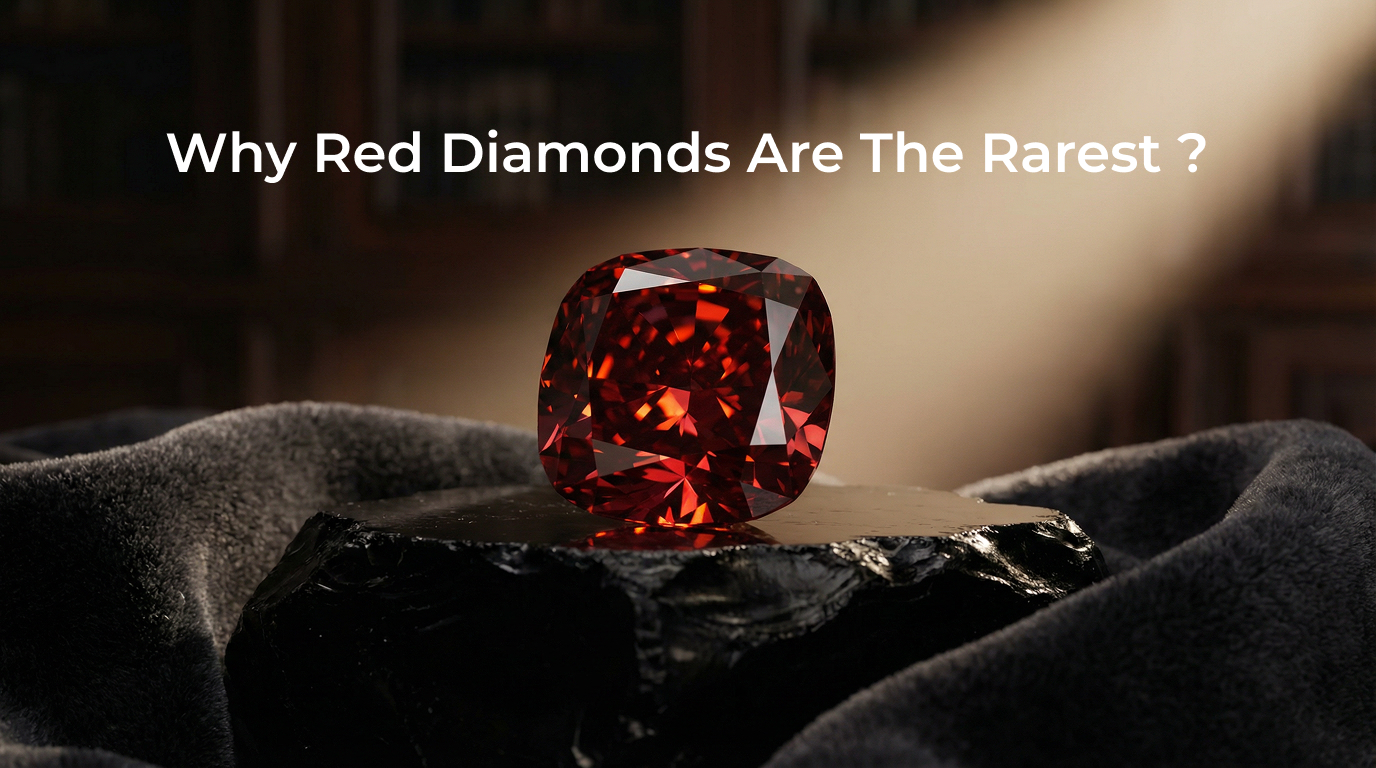
Among all the hues in the gemstone world, none captivate the imagination quite like the colour red. While blue, pink, and yellow diamonds can fetch millions, red diamonds stand in a league of their own. With fewer than 30 true red diamonds known globally, stones over half a carat are virtually priceless. Valued at ₹50–₹100 crore per carat, red diamonds are not just gems they are geological miracles and financial legends.
The Science of Red: Not Just Another Colour

Colour in diamonds comes from atomic imperfections or trace impurities. Yellow diamonds owe their hue to nitrogen, blue to boron, and green to radiation. But red diamonds are different their colour is born not from impurities but from plastic deformation.
This rare process occurs when immense pressure distorts the crystal lattice during the diamond’s journey from the Earth’s mantle to the surface. These distortions bend light, filtering out green and yellow wavelengths and transmitting only intense red. It requires a perfect storm—precise pressure, temperature, and zero impurities. The result is a hue so vivid that it glows with a liquid fire.
The Gemological Institute of America (GIA) classifies these stones as “Fancy Red” or “Purplish Red,” but never brownish or orangey—those are disqualified from the true red category.
Geological Lottery: Where Red Diamonds Hide

Nearly all red diamonds trace their origin to the Argyle Mine in Western Australia, which ceased operations in 2020. For 37 years, Argyle produced over 90% of the world’s pink and red diamonds yet yielded less than one red carat per year from 15 million total carats mined.
The mine’s lamproite pipe, formed 1.2 billion years ago, experienced immense tectonic pressure that warped carbon atoms just enough to create red’s signature lattice distortion. No other mine whether in Africa, Brazil, or India has ever replicated these precise geological conditions. With Argyle closed, the age of new red diamonds has effectively ended.
Size Matters: The 0.5-Carat Barrier

Red diamonds are not only rare they’re incredibly small. Of the ~30 known specimens:
- 0.1 carat: ~20 stones (mostly fragments)
- 0.1–0.5 carat: ~8 stones
- Over 0.5 carat: Only 4 stones
The Moussaieff Red Diamond (5.11 carats) is the largest known. Discovered in Brazil during the 1980s as a 13.9-carat rough, it was masterfully cut to enhance colour, losing 63% of its mass in the process. It is valued at over ₹160 crore and remains one of the most famous gemstones in history.
Auction Fireworks: Records That Stun
Every time a red diamond appears at auction, it breaks records. These gems attract billionaires, museums, and private collectors who view them as the ultimate portable wealth.
- 1987: The Hancock Red (0.95 ct) sold for ₹7.3 crore, setting a record ₹7.7 crore per carat.
- 2007: A 0.95-carat purplish red diamond sold for ₹9.5 crore.
- 2023: A 0.73-carat Fancy Red fetched ₹72 crore—the highest price per carat for any gem in history.
Famous Red Diamonds

1. The Moussaieff Red (5.11 ct)
Origin: Brazil, 1980s
Current Owner: Moussaieff Jewellers, London
Value: ₹160–200 crore
Fun Fact: Displayed at the Smithsonian’s “The Splendor of Diamonds” exhibition.
2. The Hancock Red (0.95 ct)
Origin: Brazil, 1956
Sold: 1987 for ₹7.3 crore
Current Owner: Private collector
3. The DeYoung Red (5.03 ct)
Origin: South Africa
Location: Smithsonian Institution, Washington, D.C.
Remarkable For: Being purchased at a flea market, mistaken for a garnet!
Investment Alchemy: Red Diamonds as Assets
Red diamonds are the blue chip investments of the gem world:
- Annual appreciation: 12–18%, compared to 5–8% for white diamonds.
- Liquidity: Can sell within days at major auctions.
- Supply shock: No new production post Argyle closure.
- Authenticity: Verified only by GIA or HRD “Natural Fancy Red” certificates.
A 0.2-carat red diamond purchased in 1990 for ₹50 lakh would now be worth over ₹10 crore—a return that outpaces gold or real estate by far.
Fakes, Frauds, and Treatments
The immense value of red diamonds makes them a target for fraud. Common imitations include:
- HPHT-treated browns: Heat-processed to simulate red hues, easily detected under spectroscopy.
- Coated diamonds: Thin red films that scratch off.
- Lab-grown reds: CVD diamonds can produce pinkish tones but never pure red, as lattice defects differ.
Only certification from GIA or HRD verifying “Natural Fancy Red” status ensures authenticity and value.
The Future: Extinction or Legacy?
With Argyle’s closure, no new natural red diamonds are being produced. The remaining stones are now divided between three destinies:
- Private vaults—secured by billionaires.
- Museum exhibits—preserved for public admiration.
- Heirlooms—passed down through generations.
While lab-grown reds may one day emerge, they will never replicate the billion-year journey and mystique of a natural red diamond.
Conclusion: Crimson Eternity
Red diamonds are nature’s ultimate rarity—formed through violent geological forces, perfected by human craftsmanship, and immortalized through legend. While white diamonds may symbolize love, red diamonds stand for something deeper: impossibility achieved. To own one is to hold a fragment of Earth’s most secret and fiery creation.
FAQs
1. How many red diamonds exist?
Fewer than 30 true Fancy Red diamonds exist worldwide, and only four exceed 0.5 carats in size.
2. Why are red diamonds only from Argyle?
Argyle’s unique lamproite geology and tectonic history produced the extreme pressure and shear forces required to create red’s lattice distortion, unmatched by any other mine.
3. What is the most expensive red diamond ever sold?
A 0.73-carat Fancy Red sold for ₹72 crore in 2023—setting a world record for price per carat.
4. Can labs make real red diamonds?
Not yet. Lab-grown (CVD) diamonds can mimic pinkish hues, but the lattice distortion required for true red cannot be artificially replicated.
5. How can I identify a genuine red diamond?
Always verify GIA or HRD certificates labeled “Natural Fancy Red.” Examine under magnification for natural graining and avoid treated or coated stones.
Related Blogs:
Leave a Reply