
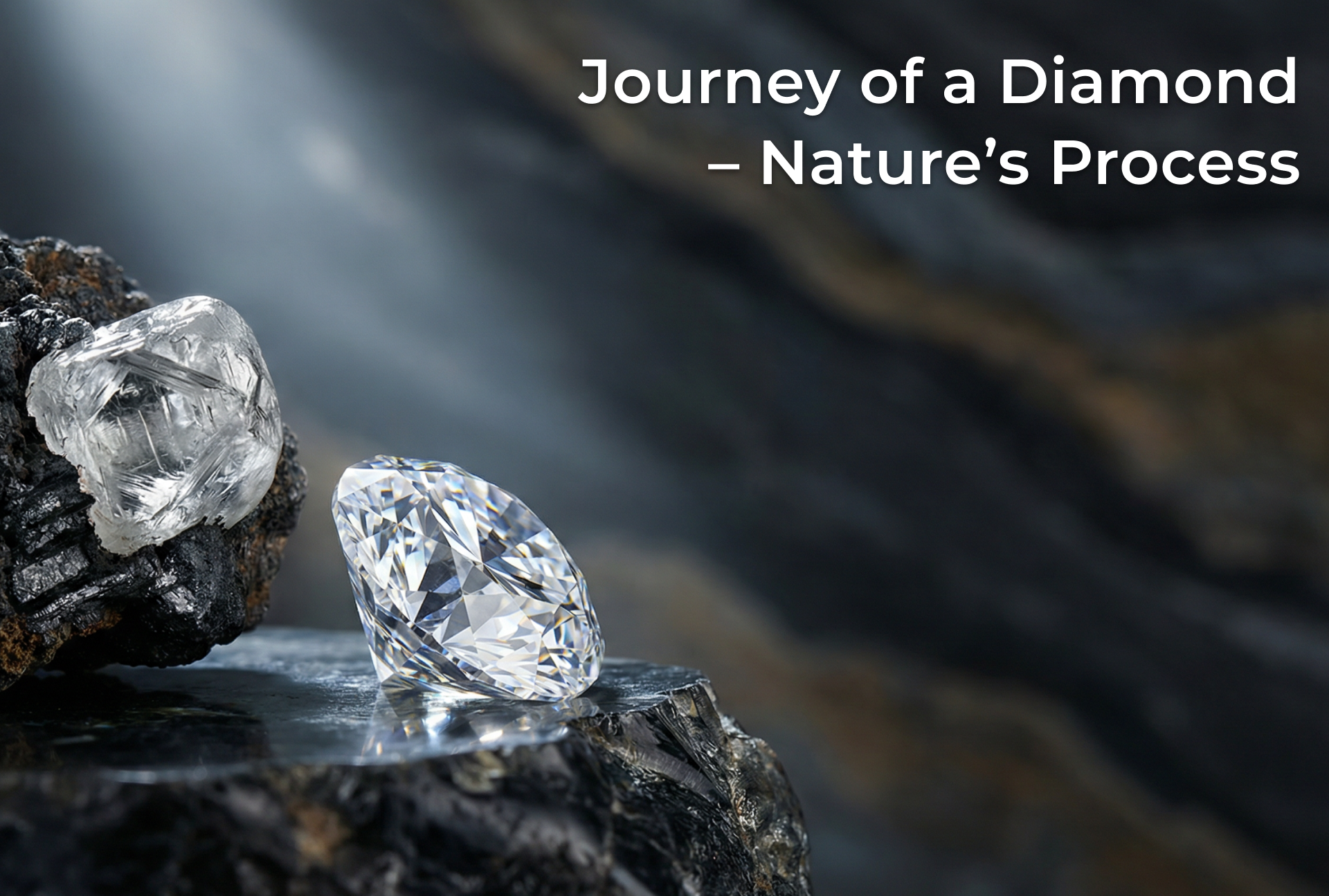
Diamonds are not mere gleaming icons of affection and affluence they are geological miracles, formed deep within Earth over billions of years. While lab grown diamonds dominate modern headlines, the story of a natural diamond’s origin remains one of the planet’s most fascinating processes.
Let’s trace how a simple carbon atom transforms into the hardest substance known to humankind, surviving immense pressure, volcanic violence, and the perilous ascent to the surface.
The Spark: Carbon in the Mantle

Every diamond begins as carbon the same element found in graphite, coal, and even our bodies. However, only a tiny fraction of carbon atoms experience the extreme conditions required for diamond formation. These conditions exist 150–200 kilometers beneath Earth’s crust, in the upper mantle, where temperatures reach 900°C to 1,300°C and pressures soar to 5–6 gigapascals.
Under these forces, carbon atoms rearrange from a hexagonal graphite structure into a compact tetrahedral lattice, forming the crystalline structure that gives diamond its unmatched hardness (10 on the Mohs scale).
Most diamonds formed between 1 and 3.5 billion years ago long before complex life appeared on Earth. Some are even older, dating back 4.25 billion years, making them some of the oldest materials known to humankind. Tiny inclusions within these diamonds preserve clues about Earth’s ancient chemistry and mantle history.
The Crucible: Kimberlite and Lamproite Pipes

Diamonds don’t remain buried forever. They reach the surface through rare volcanic eruptions involving kimberlite and lamproite magmas, which originate deep within the mantle. These eruptions are unlike any seen today extremely rapid and violent, forming carrot shaped conduits called kimberlite pipes.
As the magma ascends at speeds of 30–40 km per hour, it carries diamonds upward. If it rose any slower, the gems would revert to graphite. When it cools, the magma solidifies into a bluish rock known as kimberlite, often containing garnets, chromites, and occasionally, precious diamonds.
Out of more than 6,000 kimberlite pipes discovered globally, only about 1% yield gem quality diamonds a testament to their rarity.
The Perilous Ascent: Survival of the Fittest

The journey from the mantle to the surface is brutal. Many crystals shatter under pressure changes or revert to graphite. Only the toughest survive roughly 1 in 1,000 carbon crystals become a true diamond.
The average diamond is smaller than a pea, while extraordinary specimens like the Cullinan Diamond (3,106 carats) formed under exceptionally stable conditions. Internal inclusions within diamonds act as geological time capsules, revealing the conditions in which they grew.
Discovery: From Riverbeds to Deep Mines

Over millennia, erosion freed diamonds from kimberlite, depositing them in riverbeds known as alluvial deposits. Ancient India’s Golconda region was the earliest diamond source, producing legendary stones such as the Koh i Noor and the Hope Diamond.
In 1866, diamond bearing kimberlite was discovered in South Africa, leading to the birth of the modern diamond industry. The Kimberley Mine, dug by hand to 240 meters, revolutionized mining. Today’s operations are highly advanced open pit mines extend over 1 km deep, and marine mining off Namibia’s coast extracts diamonds from the ocean floor. In Canada’s Arctic, mines function in freezing temperatures below −50°C, demonstrating diamonds truly endure extremes.
Rarity Redefined: Why Diamonds Are Truly Rare

Despite commercial abundance, natural diamonds are astronomically rare. Only 0.0001% of Earth’s carbon becomes diamond. Of all mined diamonds:
- Only 20% are gem quality.
- 80% are used industrially (for drills, saws, and abrasives).
- Less than 1% weigh over 1 carat.
- Less than 0.001% are fancy coloured (pink, blue, or red).
Red diamonds are the rarest fewer than 30 exist worldwide, caused by atomic distortions in the crystal lattice. A 0.5 carat red diamond can be worth over ₹50 crore.
Some diamonds even have cosmic origins formed in meteorite impacts or supernovae, carrying traces older than our solar system.
The Human Touch: Cutting and Legacy

A raw diamond appears dull and unremarkable. Master cutters in Surat, Antwerp, and New York analyze each stone meticulously before shaping it into brilliance. One wrong cut can mean the loss of millions in value.
The brilliant cut with 58 facets is designed to maximize sparkle but retains only 40–60% of the rough stone. The rest becomes diamond dust, often reused in polishing other gems.
Conclusion: A 3 Billion Year Love Story
A diamond is more than a gem it’s a survivor of cosmic and geological forces, born deep within Earth, tested by fire and time, and perfected by human hands. Every natural diamond carries within it a story 3 billion years in the making, reminding us that true value is not manufactured it is forged through endurance.
FAQs
1. How long does it take for a diamond to form?
Most natural diamonds formed between 1 and 3.5 billion years ago under intense heat and pressure deep within the Earth’s mantle.
2. Why do diamonds only occur within kimberlite pipes?
Kimberlite magmas rise quickly up to 30–40 km/h bringing diamonds to the surface before they revert to graphite.
3. Can diamonds form anywhere on Earth?
No. Diamond formation requires extreme conditions found only 150–200 km below the surface at pressures of 5–6 GPa and temperatures of 900–1,300°C.
4. Are all diamonds billions of years old?
Most natural diamonds are billions of years old, but a few younger diamonds formed less than 100 million years ago in regions with more recent volcanic activity.
5. How rare are large diamonds?
Exceptionally rare fewer than 1 in a million mined diamonds exceed 1 carat. Stones over 100 carats are museum grade treasures.
Related Blogs:
- 10 Facts About Diamonds We Bet You Didn’t Know!
- How to Choose a Solitaire? A Buying Guide
- Diamond Colour Explained: From D to Z
- Diamond Clarity Explained: From Flawless to Included
- 1 Carat Diamond Price in India (2025): Factors, Trends, and Expert Buying Tips
Leave a Reply