
If you’re looking for a diamond, whether it’s for an engagement ring, studs, or just something glamorous to splurge on, you’ve likely heard of words like “carat” and “mm”.
But what exactly are they, and how do they compare? In this blog, we’re exploring the realm of diamond sizes with an emphasis on comparing mm to carats. We’ll dissect a useful diamond size chart, clarify diamond size in mm, and give you an idea of what these measurements look like in real life.
Trust me, this can be the difference maker when selecting the ideal stone without any surprises.
Diamonds are all about that “wow” factor, aren’t they? But size is not just a matter of how heavy the diamond is, it’s how it appears on your finger or in a setting. Carat is a measurement of weight, and mm (millimetres) is a measurement of actual physical size. A diamond size chart that contrasts mm with carat is really helpful because not all diamonds with the same carat weight appear the same size. The cut and shape are big influences. By the time you’ve finished reading this post, you’ll be an expert at converting mm to carat and identifying the best bargains in your price range and style.
What Is Carat Weight, Anyway?

Let’s begin with the fundamentals. Carat is a weight unit for gemstones and diamonds. One carat is equivalent to 200 milligrams, roughly the weight of a tiny paperclip. It’s not necessarily size, but the heavier the diamond, the larger it is although that’s not always true.
When jewellers say “1-carat diamond”, they mean the weight.
But then there’s this: two diamonds that are 1 carat each can appear to be a different size based on their cut.
A deeply cut diamond may weigh 1 carat but will seem smaller in appearance from above since more of its weight is below the surface. Conversely, a shallow cut distributes the weight, so it appears larger in mm.
Carat weight has been the norm since way back in ancient times when merchants employed carob seeds (which were fairly consistent in weight) to weigh gems. These days, it’s all about exact scales, but the principle is the same. More carats are more expensive, generally, but don’t forget the other Cs: cut, colour, and clarity. A dainty, perfect diamond can dazzle a larger one with flaws.
Diamond Size in MM: The Actual Visual Measurement
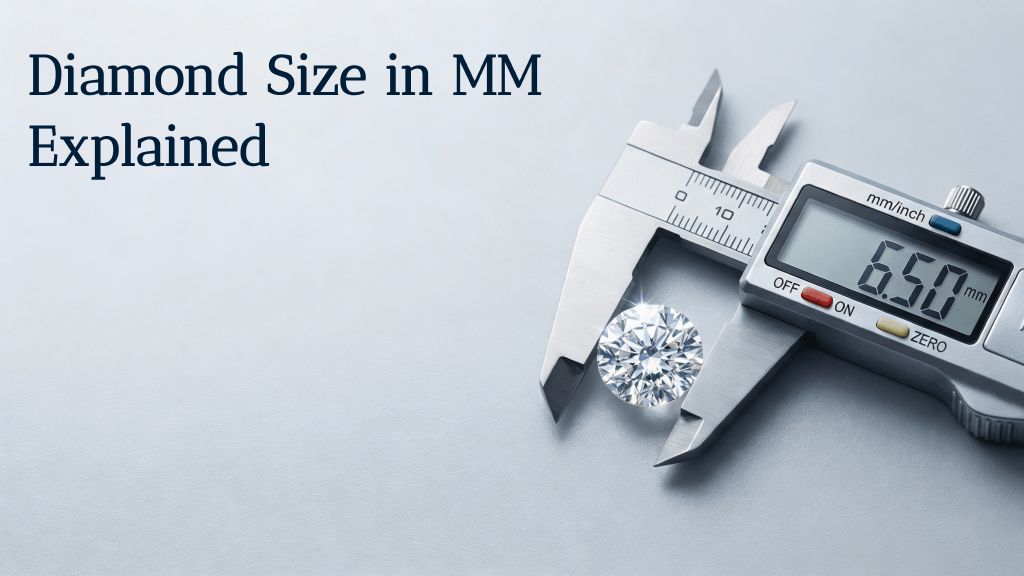
Next, we’re discussing diamond size in mm. This is what you can actually visually measure. The diameter or length and width of the face-up view of the diamond. For round diamonds, easy peasy: just the width across. For fancy shapes such as oval or pear, length by width.
Why is mm more important for pictures?
Because when you put on a diamond, you’re not measuring it…you’re staring at it! The mm measurement of a diamond will show you how much of your finger it covers or how much setting it fills. For instance, a round 6.5 mm diamond is about the size of a pencil eraser and will usually be about 1 carat. That’s the magic number for a lot of engagement rings, large enough to make an impression but not too excessive.
Measuring in mm is also useful when you shop online. You can take a ruler and measure the diamond’s size against common objects.
A 4 mm diamond? That’s the size of a toothpick tip. An 8 mm one? The diameter of a dime. This makes carat-to-mm conversions necessary for preventing that “it looked larger in the photo” letdown.
Why Compare MM to Carat? The Key Benefits

‘mm’ versus ‘carat’ isn’t just dweeby gem jargon. Carat determines the cost, but mm influences value. A diamond that cuts well with proper proportions will optimise its mm value for the carat weight, providing you with maximum bang for your buck.
Consider this:
If budget is a concern, you may choose a lower carat but a shape that is more spread out, such as an oval, to achieve a larger diamond size in mm. Or, if you want that unmistakable round appearance, having a sense of the mm equivalent helps manage expectations.
Additionally, diamond size charts simplify shopping from store to store. Whether you’re at a neighbourhood jeweller or shopping online, these charts normalise things. They indicate that diamond sizes are not linear. A 2-carat diamond is not twice as large in mm as a 1-carat one. It’s roughly 25-30% larger in diameter because volume (weight) grows quicker than surface area.
Your Go-To Diamond Size Chart: MM vs Carat for Round Diamonds

Now on to the good stuff, the diamond size chart. Here is an easy round diamond size chart based on average well-cut stones:
| Carat | Round (mm) | Melee (mm) | Oval (L × W mm) | Emerald (L × W mm) | Cushion (mm) | Pear (L × W mm) |
|---|---|---|---|---|---|---|
| 0.005 | – | 1.0 | – | – | – | – |
| 0.01 | – | 1.3 | – | – | – | – |
| 0.05 | – | 2.5 | – | – | – | – |
| 0.10 | – | 3.0 | – | – | – | – |
| 0.20 | 3.8 | 3.8 | – | – | – | – |
| 0.25 | 4.0 – 4.1 | – | – | – | – | – |
| 0.50 | 5.0 – 5.2 | – | 6.55 × 4.5 | 5.55 × 4.0 | 4.5 | 7.0 × 4.5 |
| 0.75 | 5.8 – 5.9 | – | – | – | – | – |
| 1.00 | 6.3 – 6.5 | – | 8.0 × 5.5 | 7.0 × 4.5 | 5.7 | 9.0 × 5.5 |
| 1.25 | 6.8 – 7.0 | – | – | – | – | – |
| 1.50 | 7.3 – 7.4 | – | 9.0 × 6.5 | 8.0 × 5.5 | 6.5 | 10.0 × 6.5 |
| 1.75 | 7.7 – 7.8 | – | – | – | – | – |
| 2.00 | 8.0 – 8.2 | – | 10.0 × 7.0 | 8.5 × 6.0 | 7.3 | 11.0 × 7.0 |
| 2.50 | 8.6 – 8.7 | – | – | – | – | – |
| 3.00 | 9.2 – 9.3 | – | 11.5 × 8.0 | 9.7 × 7.0 | 8.33 | 13.0 × 8.0 |
| 4.00 | 10.1 – 10.2 | – | – | – | – | – |
| 5.00 | 10.9 – 11.0 | – | – | – | – | – |
Even when using a good diamond size chart, other factors affect the wow. Cut grade is enormous, a “very good” or “excellent” cut makes light bounce better, making the stone more radiant and larger.
Setting type also plays a role: a bezel can minimise, whereas a prong admits more light.
Finger size comes into play. A 1-carat diamond on a size 4 finger appears gigantic next to a size 8. And don’t forget colour and clarity; the whiter and clearer the stone, the more it catches the eye.
Tips for Picking the Perfect Diamond Size

- Establish a budget: Carat jumps (such as 0.99 to 1.00) drive up prices, so go just below for close mm size.
- Try on: Consult printable diamond size charts or shop at a store to view mm in person.
- Think about shape: for max size on a budget, choose marquise or oval—they stretch out.
- Balance the 4Cs: Often a 0.90-carat with an excellent cut will appear more attractive than an imperfect 1-carat.
- Think long-term: bigger is not always better if it won’t fit with your lifestyle.
Conclusion
In conclusion, becoming an expert in mm to carat through a diamond size chart helps you shop wisely. Whether you’re looking at a dainty 0.5 ct or a bold 2 ct, keep in mind: it’s all about the sparkle that illuminates your life.
FAQs
How do mm and carat differ in diamonds?
MM takes the physical size you observe, and carat is weight. A diamond size chart facilitates comparison because weight is not always visible size.
How large is a 1-carat diamond in mm?
For round cut, roughly 6.3-6.5 mm in diameter, about the size of a small pea. Other shapes are different.
Can two diamonds of equal carat be of unequal mm sizes?
Yes! Shape and depth of cut influence it. A shallow cut spreads more mm than a deep one.
What is the best shape for maximum diamond size in mm per carat?
Elongated shapes such as oval or marquise tend to appear larger than rounds for equal carat.
How do I utilise a diamond size chart for online shopping?
Measure a finger or a ring with a ruler and compare the mm from the chart to see how it will fit.
Related Blogs
- What is VVS Clarity in Diamonds?
- Should You Buy SI Diamonds?
- Internally Flawless Diamonds: Are They Worth It?
- Flawless Diamonds: The Pinnacle of Perfection
- What Does ‘Included’ Mean in Diamond Clarity?
- Why GIA or IGI Certification Matters for Indian Buyers
Leave a Reply