
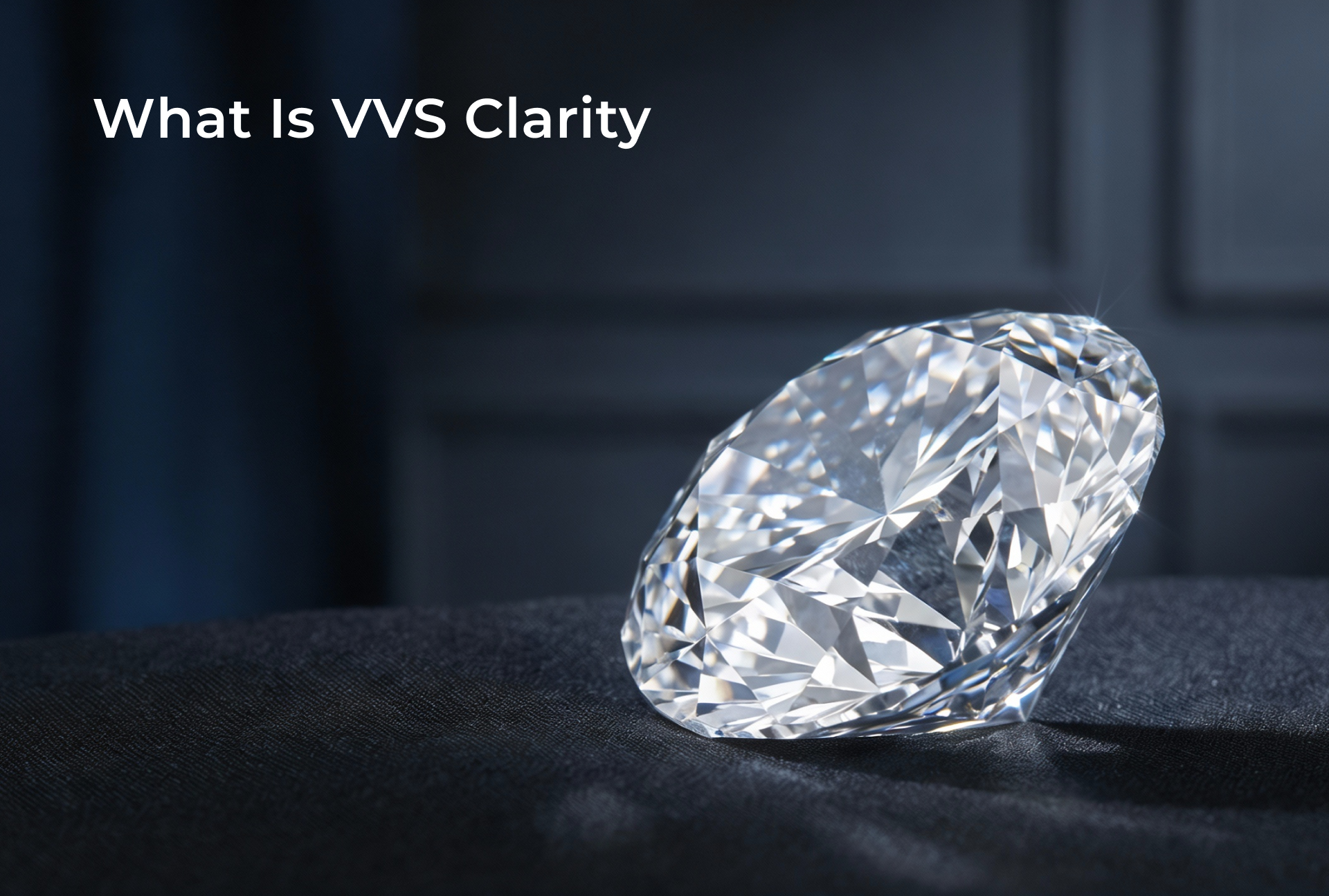
Hi there, diamond enthusiasts! If you’ve ever bought a glitzy ring or necklace, chances are you’ve heard the word “clarity” being tossed around quite a bit. It’s one of those standout factors that make diamonds sparkle, both literally and metaphorically.
Today, we’re taking a closer look at VVS diamond clarity.
What is it? Why is it important? And how does it compare to other grades? I’ll lay it all out in plain language; no techno babble here! Just easy information so you can make informed decisions.
Diamonds Clarity
Diamonds have fascinated people for centuries. Engagement rings and heirloom jewellery are symbols of love, luxury, and sometimes even an investment. But not all diamonds are equal. The well-known “4 Cs” – cut, colour, carat, and clarity, assist us in assessing them.
Clarity, specifically, is the extent to which a diamond appears “clean” both internally and externally. It’s comparable to searching for minute imperfections in a gorgeous painting.
And VVS diamond clarity? That ranks as one of the highest levels, which means the diamond is virtually flawless to the human eye.
Back to the fundamentals. Diamond clarity is the lack of inclusions (internal imperfections) and blemishes (external marks).
These occur naturally as diamonds are created deep within the Earth under pressure and high heat. Consider inclusions to be small crystals, feathers, or clouds that become stuck inside the stone.
Blemishes might be surface scratches or pits. The Gemological Institute of America (GIA), the gold standard for diamond grading, has a scale to rate clarity. It goes from Flawless (FL) at the top to Included (I) at the bottom.
What is VVS Clarity in Diamonds?

VVS is short for Very Very Slightly Included.
It’s just a step below Internally Flawless (IF) and Flawless but significantly above those more typical grades of SI (Slightly Included) or VS (Very Slightly Included). In VVS diamonds, inclusions are so minute that even a professional gemologist requires a 10x magnifying loupe to detect them.
To me and you? They appear flawless.
There are two sub-grades, VVS1 and VVS2. VVS1 indicates the inclusions are very difficult to see, usually situated at the bottom or side of the diamond. VVS2 inclusions may be slightly easier to spot under magnification but are still incredibly small. Both are great options if you desire that ‘wow’ factor without spending a fortune on a flawless stone.
Why worry about VVS diamond clarity?

Well, clarity determines how much light will bounce around within the diamond, influencing how brilliant and sparkling it appears. The clearer the diamond, the more light passes through, which makes it seem brighter and more vibrant. And in larger diamonds (e.g., above 1 carat), defects are more apparent, so greater clarity like VVS becomes even more significant.
VVS vs VS
Now, let’s discuss VVS vs VS diamond clarity, a popular comparison when buying. VS means Very Slightly Included, and it’s split into VS1 and VS2.
The key difference?
In VS diamonds, inclusions are slightly bigger or more noticeable under 10x magnification. They could be tiny spots or little feathers that an expert can find without too much effort.
In the VVS vs VS battle of the diamond, VVS takes the prize for purity. But here’s the real human factor: all but a few individuals can’t see the difference with the naked eye. A VS diamond could potentially have a feather or crystal you’d catch if you know what you’re looking at under a loupe, but in real-life wear? It’s gorgeous.
VVS is the premium upgrade. Best for perfectionists or if the diamond is large and being eye-clean is really important.
Price-wise: VVS diamonds are more expensive since they’re less common. Fewer than 10-15% of diamonds evaluated by GIA are VVS quality. VS diamonds are more common, so they’re affordable yet still stunning. For instance, a 1-carat round diamond with VVS clarity will set you back 20-30% more than its VS counterpart, depending on the other Cs.
But clarity is not the only factor. A well-cut diamond of VS clarity may outshine a poorly cut VVS one. Always weigh the 4 Cs. And keep in mind, some inclusions aren’t necessarily bad, they can be like a diamond’s fingerprint, something each stone has uniquely.
How do gemologists grade VVS diamond clarity?

They examine five factors: size, number, position, nature, and relief of inclusions.
- Size: The smaller, the better.
- Number: Fewer inclusions, higher grade.
- Position: Inclusions in the centre are worse than on the edges.
- Nature: Some inclusions, such as crystals, are less noticeable than others, such as clouds.
- Relief: How much the flaw protrudes relative to the colour of the diamond.
If you are purchasing a VVS diamond, demand a GIA or AGS report. These laboratories are neutral and thorough. Don’t buy from people who grade their own diamonds, that’s like grading your own homework!
Real talk
I’ve spoken to friends who struggled with VVS vs VS diamond selections for engagement rings. One friend went VVS because his fiancée desired the best, and it made her feel special. Another chose VS in order to save for a larger carat. Both were content. It’s personal.
Taking care of your VVS diamond?
Clean it carefully with warm soapy water and a soft-bristled brush, and steer clear of harsh chemicals.
Have it inspected annually by a jeweller to make sure prongs are tight.
Ethically, choose conflict-free diamonds. Seek Kimberley Process certification.
Lab-created diamonds have VVS clarity at more affordable prices and are environmentally friendly.
In short, VVS diamond clarity is near-perfection. Very small inclusions that won’t dull the fire. Whether VVS or VS, pick what suits your style and budget.
Going deeper in history
diamonds were originally mined in India more than 2,000 years ago. Clarity grading in the 20th century developed with GIA in 1953. Prior to that, it was subjective.
Typical inclusions in VVS diamonds?
Pinpoints (small crystals), needles (long thin formations), or indigents (small specks of minerals). In VVS, they’re microscopic.
VVS vs VS diamond in investment?
Greater clarity is more valuable to hold, but diamonds are not fast flips like stocks.
Shopping tips
Look at it under various lights. Request a loupe. Compare side-by-side.
In VVS vs VS diamonds
VS is useful for everyone. But if you envision the best, VVS provides that.
Cultural titbit
Flawless diamonds in some cultures represent true love.
Tech developments
Improved mining and cutting offer more VVS.
Conclusion
In the future, lab-grown VVS may reign supreme.
Summing up the blog, I’d say that VVS diamond clarity is top-shelf but still affordable. Learn, and you’ll discover your ideal gem.
FAQs Regarding VVS Diamond Clarity
What does VVS mean in diamonds?
VVS refers to Very Very Slightly Included. It refers to diamonds with minute inclusions that are difficult to observe even with magnification.
Is VVS superior to VS clarity?
Yes, in the VVS vs VS diamond comparison, VVS contains smaller and fewer flaws. But VS appears fantastic to the naked eye and is cheaper.
Can you view inclusions in VVS diamonds?
Nah, without a 10x loupe you can’t view any inclusions in VVS diamonds. They’re eye-clean and glitter beautifully.
How much more are VVS diamonds?
They may be 20-50% more expensive than comparable VS diamonds, depending on carat weight and other considerations. Shop around to find out!
Should I purchase a VVS diamond for an engagement ring?
If you desire the best quality and can spend the money, yes. Otherwise, VS is a good, lovely choice.
Related Blogs
- Where Are Diamonds Found in the World? Top Producing Countries
- Where Are Diamonds Found in India? States & Mines Explained
- The Most Expensive Diamonds in the World (2025 List)
- What is the 777 carat diamond?
- VS Diamonds: Meaning, Price, and Comparison
Leave a Reply