
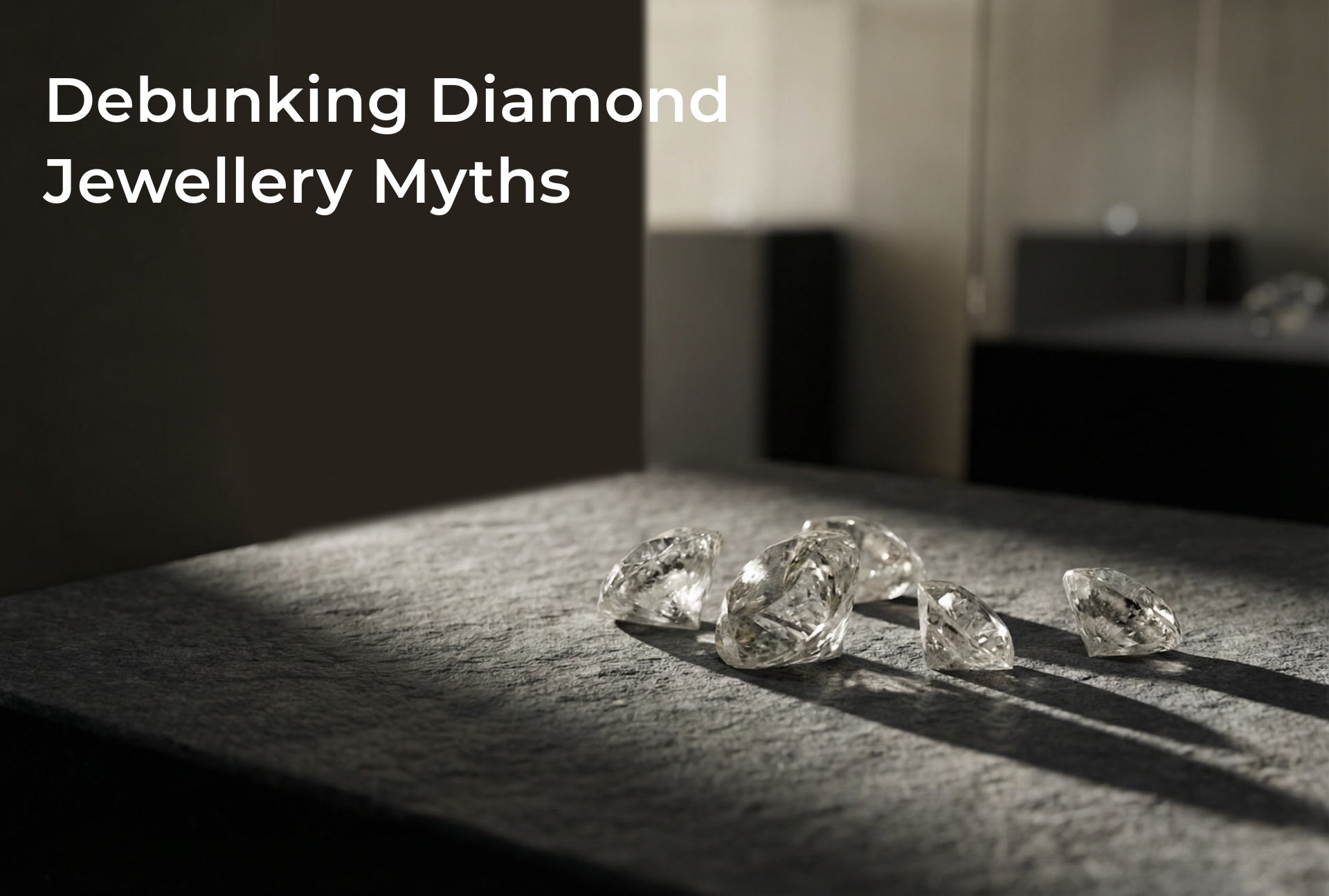
Diamonds have long symbolized love, luxury, and eternity—but over the decades, myths surrounding them have clouded consumer judgment. From marketing slogans to movie glam, these misconceptions persist even in today’s transparent jewellery market.
Let’s bust the seven biggest diamond jewellery myths with facts, science, and expert insight so you can make smarter, more informed purchases.
Myth 1: Diamonds Are the Hardest Substance on Earth—So They Are Indestructible

Diamonds top the Mohs scale at 10, meaning they’re the hardest natural material. However, hardness measures scratch resistance, not toughness. Diamonds have cleavage planes, meaning a sharp impact at the right angle can cause them to chip or fracture—just like glass.
Reality Check: Jewelers cut diamonds using other diamonds. Even large roughs like the 1,109-carat Lesedi La Rona were only safely cut after internal stress mapping. Everyday wear can still lead to small chips or cracks.
Pro Tip: Insure your jewellery and remove rings during manual work. Avoid ultrasonic cleaners if the setting is loose, as vibrations can weaken prongs.
Myth 2: A Diamond’s Value Always Appreciates—It’s a Sound Investment

De Beers’ 1940s campaign “A Diamond Is Forever” was emotional genius—but financially misleading. Retail markups average 100–200%, and resale values often disappoint.
Reality Check: According to the Rapaport Price List, a 1-carat G-color, VS2-clarity round sold for $8,000 in 2015 and fetched $4,200 at auction in 2024—a 47% loss. Even pink diamonds have cooled since the Argyle mine closure.
Conclusion: Diamonds are wearable art, not investments. Only rare fancy-coloured stones above 3 carats with exceptional provenance tend to appreciate.
Myth 3: All Lab-Grown Diamonds Are “Fake” or Inferior

False. Lab-grown diamonds created through CVD or HPHT processes are chemically and physically identical to mined diamonds. The FTC officially recognized lab-grown diamonds as real in 2018.
Fact: Independent testing by IGI shows no optical or thermal difference. Consumer Reports found that 73% of participants couldn’t distinguish lab-grown from mined stones under magnification.
Price & Ethics: Lab diamonds cost up to 80% less than mined ones and have 90% less environmental impact. However, resale markets are still developing.
Myth 4: Blood Diamonds Are Still Flooding the Market

The 2006 film Blood Diamond depicted 1990s-era conflict stones. Today, over 99.8% of the global supply is certified through the Kimberley Process, which ensures traceability.
Fact: Modern tools like De Beers’ Tracr blockchain and IBM’s TrustChain record every transaction from mine to market. Amnesty International reports that less than 0.2% of global diamonds have conflict ties.
Tip: Always ask for Kimberley Process certificates or purchase from RJC-certified retailers for full transparency.
Myth 5: Bigger Carat Weight Means a Better Diamond

Carat weight measures mass, not beauty. A poorly cut 2-carat stone can look smaller and duller than a well-cut 1.5-carat diamond.
Fact: Cut accounts for about 40% of a diamond’s brilliance. A 1-carat “Excellent” cut round measures about 6.5mm across, while a “Fair” cut of the same weight looks smaller and leaks light.
Pro Tip: Prioritize cut quality over carat size. It’s better to have a smaller, dazzling diamond than a larger dull one.
Myth 6: You Must Spend Two Months’ Salary on an Engagement Ring

This rule was invented by De Beers’ marketing team in the 1980s and was never a financial standard.
Reality: Today, the average spend in India is ₹4,62,000, with millennials spending far less. A stunning 2-carat lab-grown diamond ring can cost just ₹1,68,000—proof that meaningful doesn’t mean expensive.
Modern Mindset: Buy within your comfort zone and focus on emotional significance rather than arbitrary rules.
Myth 7: Diamonds Require Only Professional Cleaning

While professional ultrasonic cleaning is excellent, regular home cleaning keeps your diamonds sparkling longer.
Method: Soak your jewellery in warm water with mild dish soap for 10 minutes, gently scrub with a soft toothbrush, rinse, and pat dry.
Fact: Diamonds attract skin oils, dulling their sparkle. Avoid chlorine or bleach, as they damage metal alloys. Store pieces separately in soft pouches to prevent scratching.
Conclusion
Myths persist because they’re easy to believe—but data and science reveal the truth. Today’s buyers have access to transparency, certification, and ethical sourcing. Whether you choose a mined or lab-grown diamond, let knowledge—not marketing—guide your brilliance.
FAQs
1. Are lab-created diamonds real diamonds?
Yes. They have the same physical, chemical, and optical properties as mined diamonds. Only advanced spectroscopy can distinguish them.
2. How can I tell that a diamond is not a conflict stone?
Ask for Kimberley Process certification and the retailer’s Responsible Jewellery Council audit. Blockchain-tracked stones come with verified digital passports.
3. Will my diamond lose value immediately after purchase?
Yes, most diamonds lose 40–60% between retail and resale due to markups. Long-term value depends on rarity, color, and provenance.
4. Is it safe to wear diamond rings daily?
Yes, but take precautions. Remove them during heavy lifting, gardening, or swimming. Annual prong checks prevent stone loss.
5. Can I insure a lab-grown diamond ring?
Absolutely. Most insurers cover lab-grown diamonds at agreed replacement value when accompanied by IGI or GIA certification.
Related Blogs:
Leave a Reply