
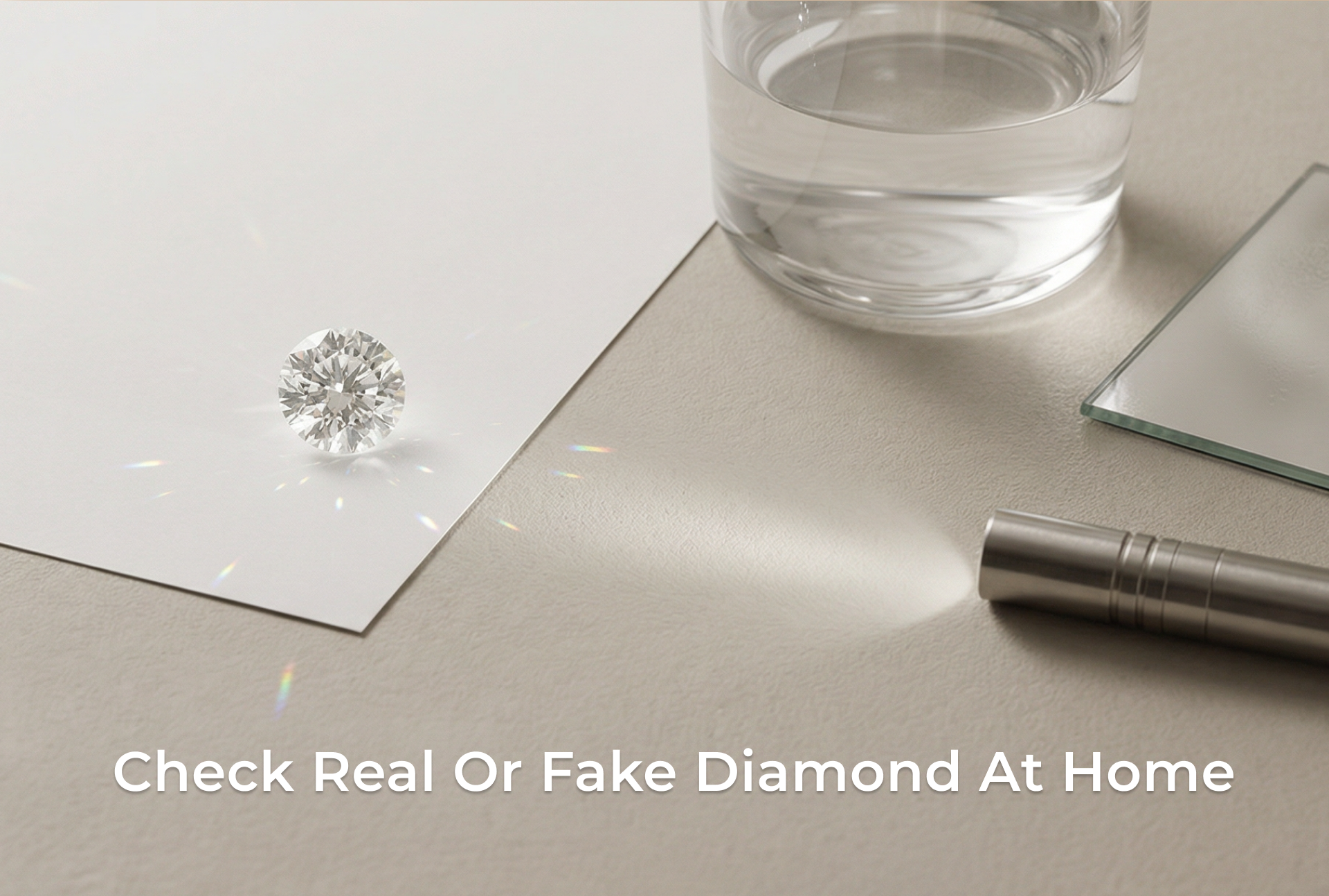
Diamonds are a girl’s best friend. A good set of diamond jewellery just makes life better. However, with an increasing number of scams and impure diamonds being sold widely, it is important to make sure that the diamonds you own are pure and authentic.
However, many of us do not have the time to visit a jeweller and verify the authenticity.
Easy Tests to Identify a Real Diamond at Home

Diamonds are sentimental investments. Oftentimes, these are gifts which we have received from our loved ones to mark special occasions. It is always better to know the value of such gifts so that you can wear them and take care of them accordingly. But at times when you barely have time for yourself, taking the time out to visit the jeweller might not be feasible, especially if you are in a hurry. In such a case, there are certain tests you can easily conduct at home that can help you determine the purity of diamonds.
Listed below are all the commonly asked questions that we will be covering in this blog:
- What “diamond purity” really means
- How to test diamond authenticity at home
- How to spot fakes like cubic zirconia or moissanite
- What tools you can use
- When to consult a professional
What “diamond purity” really means
For many people, the first question that comes to mind is, what exactly is diamond purity? Is it only a question of whether a diamond is real or not, or are there more parameters to it?
Diamond purity is very different from checking whether a diamond is real or not. Most home tests check whether a diamond is real or not, as checking its purity requires microscopic inspection that can only be done by a professional jeweller.
Key Differences:
The table given below mentions certain factors that differentiate diamond purity from checking whether the diamond is real or not.
| Feature | Diamond Purity | Whether Diamond Is Real |
|---|---|---|
| Definition | Checking the degree of internal/external flaws | Checking whether the diamond is natural or synthetic |
| Applies to | Only real diamonds (natural or lab) | Any stone labeled as a “diamond” |
| Graded by | GIA clarity scale | Testing authenticity (physical/chemical tests) |
| Can a fake have high purity? | Technically yes — but it’s still fake | Not relevant if it’s not a real diamond |
Most home tests focus on checking whether a diamond is real or fake, as advanced purity or clarity assessments require microscopic inspection.
Purity in diamonds refers to checking three major points that include-
- Clarity – Clarity refers to how spotless and flawless a diamond is.
- Authenticity – Authenticity means checking whether the diamond is real or not.
- Composition – Composition refers to knowing whether the diamond is natural or lab-grown.
1. Visual Inspection: What to Look For
Start with a simple visual check:
When you are at home and wish to check the purity of your diamond, the first thing to do is conduct a visual check.
Sparkle Test
When checking for sparkle, real diamonds reflect light in a sharp, brilliant sparkle, whereas fake stones such as glass or zirconia look very dull and flash only rainbow hues.
This is the quickest and easiest way to check diamond purity at home. Simply check the way a diamond sparkles. A real diamond reflects light in a sharp, brilliant sparkle, whereas a diamond substitute, such as glass or zirconia, looks very dull and flashes only rainbow hues.
Check for Flaws
A diamond that looks too good to be true is actually too fake to be true. Natural diamonds usually have tiny inclusions or internal marks on them. Chances are that a diamond that looks too flawless and has zero specs might be synthetic or fake.
2. Fog Test: The Breath Check
This is one of the simplest ways to test a diamond at home. Hold the diamond close to your mouth and fog it up with your breath. This may sound silly, but real diamonds heat up quickly, so the fog disappears within one to two seconds. Fake stones, on the other hand, stay fogged for about 5 to 10 seconds before clearing.
3. Water Drop Test: Check Density
The water drop test is a very basic and simple test done at home to check whether the diamond is real or not. Real diamonds are extremely dense. This is why, when put in a glass filled with water, real diamonds sink straight to the bottom. A fake diamond, on the other hand, may float or sink slowly.
4. Scratch Test: Hardness Check
Diamonds are the hardest natural material on earth, making them hard to crack or break. This test is basically a hardness check where the diamond is scratched on a mirror or glass surface.
They are rated 10 on the Mohs scale, so they will not break under pressure, unlike fake diamonds. So while doing this test, keep in mind that the stone can break.
5. Newspaper Read Test: Refractivity
The name might sound confusing, but the test is very simple. You place the diamond table side down on a printed text or a newspaper. Basically, a real diamond reflects light so strongly that letters written in a newspaper might appear blurry or invisible. Fake stones, on the other hand, might allow you to read those letters. Once again, this is not a foolproof method, and the results might be inconclusive or wrong. If you wish for completely accurate results, then you have to get your diamonds checked professionally.
6. UV Light Test (Black Light Test)
The UV light test is quite effective and pretty easy to perform as well. Also known as the black light test, you basically shine a UV light on the diamond in a dark room, and depending upon whether the diamond is real or not, it shines differently.
- If the diamond were real, then it would glow blue.
- Bright colours such as green, yellow or orange may indicate the stone being synthetic, i.e., fake.
- If there is no glow, that doesn’t mean that the diamond is fake. Some diamonds simply have no fluorescence.
7. Loupe or Magnifying Glass Check
You would need a very strong magnifying glass or a 10x jeweller’s loupe to inspect the diamond. You are basically trying to look for-
- Inclusions or tiny natural imperfections
- Sharp, clean facet edges
- Laser inscriptions (for certified stones)
Fake diamonds may have bubbles, seams or smooth rounded facets. So, if you see any bubbles in the stone, chances are, it’s a fake.
8. Heat Resistance Test (Handle with Care!)
Precaution – A fake diamond might shatter due to thermal shock; do this experiment at your own risk.
Diamonds can resist extreme heat, unlike other gemstones. So we heat the diamond over a flame for about 30 seconds and then immediately drop it into cold water. A real diamond will not be affected at all, whereas a fake one might shatter due to thermal shock.
9. Using a Diamond Tester (Electronic Device)
If you are willing to invest 1,000 to 3,000 rs to check whether the diamond is real or fake, purchase a diamond tester. This pen-like tool measures thermal conductivity. You use it by placing the tip of the tester on the diamond and waiting for a signal. Real diamonds register quickly.
The one drawback of the diamond tester is that moissanite may also pass unless you use a better tester that detects both heat and electrical conductivity.
10. Check for Certification or Hallmarking

Authentic diamonds will always contain hallmarks like ‘750’ (for 18K gold) or ‘916’ (for 22K gold). Many diamonds also have certification cards with them, such as GIA, IGI, SGL, HRD, etc. You can also try looking for a laser inscription on the diamond girdle. Certified jewellery ensures authenticity and quality standards.
Common Fake Diamonds and How to Spot Them

| Material | Appearance | How to Spot |
|---|---|---|
| Cubic Zirconia | Brilliant but rainbowy sparkle | Light fog stays longer, less dense |
| Moissanite | Looks like diamond, lots of fire | Use combined diamond+moissanite tester |
| White Sapphire | Less brilliance | Lower hardness (scratches glass faintly) |
| Quartz/Glass | Dull shine, visible bubbles | Fails fog, water, and hardness tests |
How to Know If a Diamond is Real: Combine Multiple Tests
Each test has its limitations. The best approach is to use 2–3 tests together:
- Fog and water test for basic validation
- UV + loupe for next-level check
- Use a diamond tester for certainty
- Get a jeweller’s opinion if still unsure
Why Choose BlueStone for Your Jewellery Purchase?
Our jewellery is only made of BIS-hallmarked gold and certified diamonds.
- Our versatility is unmatched. When it comes to diamonds, we have a plethora of options to choose from.
- Our jewellery is customisable as per your preference.
- We provide fast shipping, insured delivery and beautiful gift-ready boxes.
Whether you’ve inherited a stone, received a gift, or are buying online, knowing how to test a diamond at home puts you in control. While DIY methods won’t replace professional certification, they can protect you from scams and help you verify authenticity before purchase or resale.
When in doubt, choose certified jewellery—like the kind you’ll find at BlueStone—to ensure beauty, value, and peace of
mind.
FAQs: How to Check Diamond Purity at Home
Q1. Can I check if a diamond is real at home?
Yes, simple tests such as the fog test, water test, UV light test and magnifying glass inspection can help you determine whether a diamond is fake or not.
Q2. What is the most reliable home test for diamonds?
Most accurate results can only be determined with the help of professional tools. Keeping reliability and safety in mind, the fog test and water test are simple and easy to follow.
Q3. What does a real diamond look like under a flashlight?
A real diamond would sparkle white with intense fire-like flashes. Kale diamonds, on the other hand, are more inclined to show rainbow colours and less sharp brilliance.
Q4. Can fake diamonds scratch glass?
Yes, some fake diamonds like moissanite can scratch glass. This is why scratch glass tests aren’t very reliable.
Q5. Is certification necessary to prove a diamond is real?
Yes, while home tests can help you determine their purity, only professional certification from GIA, IGI or SGL can confirm a diamond’s authenticity and value.
Related Blogs
- How to Measure Your Ring Size at Home: 5 Easy & Accurate DIY Methods
- Ring Size Guide: How to Know, Measure & Calculate the Right Fit (in CM)
- Decoding Meaning of Wearing Rings on Each Finger
- Know the Right Hand & Finger to Wear Your Engagement Ring
- Which Finger to Wear a Ring On If You’re Single, Not in a Relationship
- What is Portrait Cut Diamonds? Everything You Need to Know About Pricing, Quality & Buying Guide
Leave a Reply