
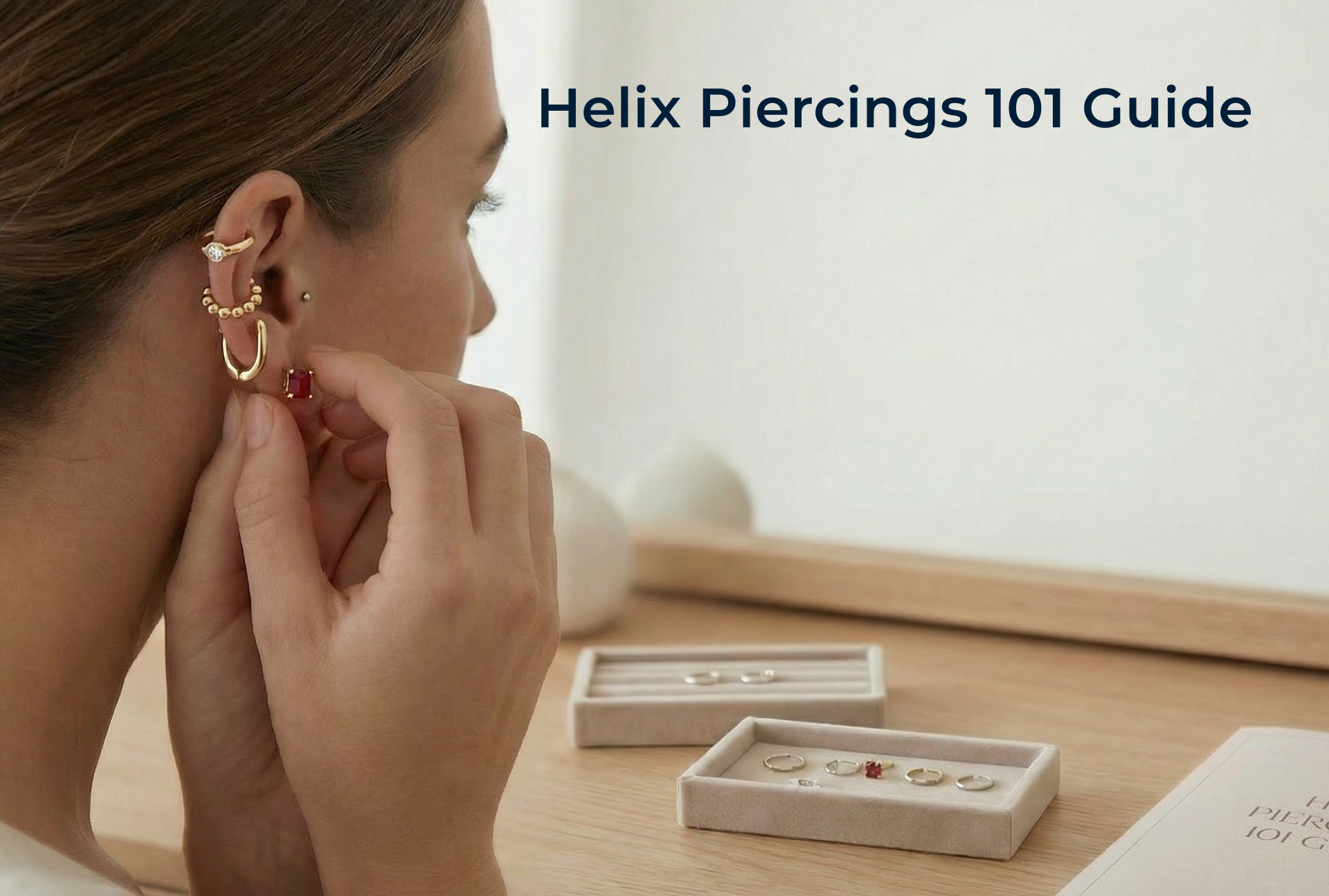
If you are considering a dash of sparkle in your top ear, helix piercings could be just the thing. These stylish little additions have blown up in popularity, offering understated edges mixed with limitless styling possibilities. Whether you are looking for classic Helix Earrings like simple studs or something more glam with Diamond Earrings and intricate Gold Earring designs, we have got you covered.
In this blog we will dive into everything from the basics of what a helix piercing actually is, to the nitty gritty of pain, healing, jewellery picks, costs, risks, and how to rock them with your other ear bling.
Understanding Helix Piercings: The Basics and Variations
What is a helix piercing?

It is basically a hole drilled into the top cartilage of your ear the bony, curved outer edge that borders the top section. Unlike a typical lobe piercing, which passes through soft tissue, this one is in harder cartilage, which makes it have that trendy, raised appearance. Helix Earrings ride directly along that ridge, which is why they are a go to for anyone assembling a manicured ear stack.
Of course, not every helix piercing is the same. There is the classic single helix, which is simply one on the outside edge, typically towards the top. A double stacks two vertically, one atop the other, for a more dramatic look, and a triple ups the ante with three in a line along the curve of the ear. These multiples do create a beautiful line of shine, particularly with coordinating Stud earrings.
Then there is the forward helix, which is positioned closer to where your ear meets your head, on the inner cartilage above the tragus. It is subtler and often feels more hidden but can be doubled or tripled. There is a flat helix (often referred to as a mid or flat cartilage piercing) that rests on the flatter section of the top ear, not near the outer edge basically, it fills in that broad, flat space for an interesting location. And then there is the lower helix near the lobe, or the upper helix up toward the rim. Each is different depending on the shape of your ear, so talking with an expert piercer is most important to determine what works best for you.
The big differences – Type of Helix Piercing?
Single Helix Piercings are simple and heal on their own, but doubles or triples require more room and time in between appointments. Try at least four months apart to prevent irritation. Forward helixes tend to be more problematic because the cartilage is thinner and may sting a little harder, an 8/10 on the pain scale versus a normal helix’s 6/10. Flat ones provide more space for creative jewellery but may engorge differently due to the wider cartilage area.
Pain, Healing Time, and How to Care for Your New Helix Piercing

Pain
On a pain scale of 1 to 10, most find a helix piercing a 5 or 6. It is a fast pinch or sting, more than the lobe but less than something like a daith. The forward helix could increase that to an 8 or a 7 because it is in a more delicate area. Pain goes away quickly, though, with only some tenderness for a couple of days.
Healing
Cartilage is slow and sweet. Allow 6 to 12 months for complete healing, with the first 9 months being essential. The first few weeks will be swollen, reddened, and possibly have crusty discharge.
Aftercare is not optional
Clean twice a day with saline spray or mild soap spray both sides, let it soak, and pat dry with a paper towel. Wash your hands first, and avoid twisting the jewellery; it can tear the healing tissue. Skip swimming pools, hot tubs, or beaches for the first 6-8 weeks to dodge bacteria.
Selecting the Right Jewelleryfor Helix Piercing: Styles, Sizes, and Materials

Jewellery breaks or makes your helix style. To begin with, try simple ones such as Stud earrings or flat backs these come with a flat disc at the back to rest softly against the ear without piercing. Hoops are in vogue too, particularly tiny huggies or clickers (those snap on rings) for a smooth look. When healed, you can try chains joining several piercings or swoopy barbells for edginess.
Sizes count when it comes to fit and recovery. Normal gauges are 16G or 18G, and post lengths of 6mm to 8mm longer ones (8mm) for new piercings to accommodate swelling, then revert to 6mm for tightness. Hoop sizes? About 6-8mm for that delicate look.
Gold Earring styles sparkle here, from simple bars to Diamond Earrings for the high end flash. Sterling silver is fine for healed piercings but may irritate new ones.
Costs: What You’ll Pay for the Piercing and Bling
Budget wise, a helix piercing costs ₹2,000–₹3,000 in a well
established studio, location and piercer dependent. That typically covers the service but not the jewellery add ₹800–₹1,000 for plain titanium studs. More elaborate types such as Diamond Earrings or tailor made Gold Earring designs can stretch jewellery prices.
Potential Risks and How to Avoid Them
No piercing is risk free, and helix ones in cartilage are prone to issues if not taken care of. Infection is the big one: watch for excessive redness, swelling, pus (yellow/green discharge), or fever. Poor aftercare or dirty hands can cause this, so stay vigilant. Scarring, such as keloids (bumps that rise above the skin), is another one more frequent in cartilage and often hereditary. If you are susceptible, speak with a doc beforehand. Irritation bumps may appear but typically resolve with time and proper attention.
Styling Ideas: Combining with Other Ear Piercings

Front helixes are rad paired with daith hoops for symmetry. Play with contrast: combine Gold Earring styles with silver for sleekness, or stack Diamond Earrings across multiples for shine. Attempt chains connecting your helix to a lobe, or huggie hoops in a triple for an elegant look. The trick? Balance don’t jam small ears. Play with themes such as all gemstones or blended metals to personalize it.
Frequently Asked Questions
Q1. After how long can I switch my helix jewellery?
Helix jewellery should be switched after at least 6-9 months to prevent infection or scarring. Your piercer may be able to downsize sooner if necessary.
Q2. Is a helix piercing more sensitive than a lobe?
Yes, helix piercing is a little more sensitive since cartilage is harder but it is fast and manageable.
Q3. What if my helix piercing becomes infected?
Clean it thoroughly with saline twice daily and consult a professional if symptoms worsen. Antibiotics may be necessary in severe cases.
Q4. Can I use headphones with a new helix?
Gently, but with no pressure. Over ear headphones are preferable to inear while healing.
Q5. What is the best metal for sensitive ears?
Titanium or 14K gold they are hypoallergenic and ideal for healing.
Related Blogs:
Leave a Reply