
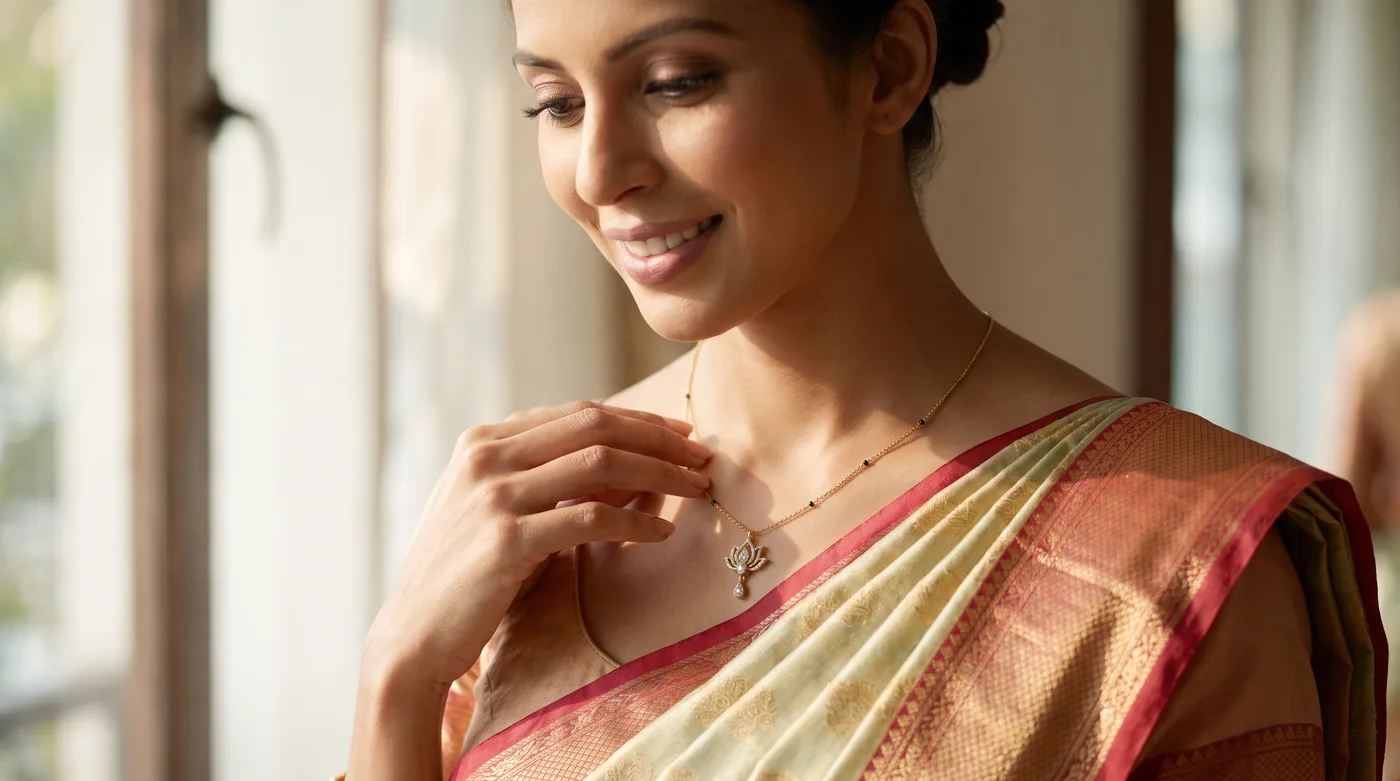
By Satyam, BlueStone Editorial
A sacred gold Hindu mangalsutra design is far more than an exquisite jewel: it is the primary emblem of marital sanctification, mutual commitment, and spiritual protection in Hindu culture. Originating from the ancient Sanskrit words Mangala (auspicious) and Sutra (thread), this consecrated ornament unites divine spiritual symbolism with everyday adornment. Whether you are a bride preparing for your wedding ceremony or seeking a comfortable daily piece for office wear, selecting the right gold Hindu mangalsutra design requires understanding traditional regional motifs, gold purity standards, chain ergonomics, and hallmarking rules.
In modern Indian jewellery design, the traditional black and gold bead necklace has evolved dramatically. Today’s brides demand heirloom craftsmanship that honors Vedic heritage while offering the featherlight comfort necessary for active, contemporary lifestyles. This comprehensive 2026 buying guide breaks down everything you need to know about choosing an authentic gold Hindu mangalsutra design, from 22K versus 18K purity breakdowns and regional emblem meanings to bead weight deductions and BIS hallmarking verification.
Quick Buyer Summary: Essential Mangalsutra Decisions at a Glance
- Auspicious Symbolism: Combines radiant gold representing Goddess Shakti with protective black beads (*kalo pote*) representing Lord Shiva to absorb negative energies and shield the marital bond.
- Purity Selection: Choose 22K yellow gold for traditional bridal richness and ceremonial heirlooms, or 18K hallmarked gold for higher tensile durability, active daily wear, and secure diamond settings.
- Chain Length and Ergonomics: An 18-inch princess length provides the most versatile collarbone-grazing drape for contemporary workwear and sarees, while 16 inches offers minimalist choker subtlety and 24 to 30 inches delivers regal bridal majesty.
- Weight Deduction Truth: Always confirm your invoice calculates gold charges exclusively on net gold weight after deducting black glass, onyx, or lac core weights.
- Statutory Hallmarking: Verify the mandatory 6-digit alphanumeric HUID hallmark laser-engraved on both the central pendant bail and the chain clasp tab.
- Ergonomic Integrity: Prioritize hand-twisted gold wire jump rings and spring-loaded lobster clasps over fragile cotton threads and open S-hooks to prevent accidental loss.
What Defines an Authentic Gold Hindu Mangalsutra Design? Sacred Vedic Roots and Marital Symbolism
The cultural foundation of the Hindu mangalsutra dates back thousands of years. While early Vedic texts describe the bride being adorned with a sacred yellow cord dyed in auspicious turmeric paste to invoke divine blessings, the evolution into an ornate necklace of fine gold and protective black beads emerged as a lasting pan-Indian tradition. During the Hindu wedding ceremony, the groom ties the consecrated necklace around the bride’s neck during the pivotal Mangalya Dharanam ritual, accompanied by Vedic mantras that invoke lifelong companionship, health, and spiritual harmony.
During the sacred Saptapadi (the seven holy steps around the sacred Agni fire), the bride and groom exchange solemn vows of emotional fidelity, shared prosperity, and mutual respect. The mangalsutra tied during this consecration is formally sealed with three traditional knots: the first knot tied by the groom symbolizing his lifelong commitment, and the subsequent two knots tied by his sister or mother, welcoming the bride into the collective harmony of her marital household.
Central to every authentic Hindu mangalsutra design is the sacred balance between gold and black beads. In Hindu philosophy, gold represents pure solar energy, prosperity, and the radiant grace of Goddess Lakshmi and Goddess Parvati. Conversely, the black beads, historically known as kalo pote or black glass/spinel beads, embody the protective, grounding power of Lord Shiva. According to sacred tradition, these black beads act as a spiritual filter, absorbing ill will, jealousy, and the evil eye (*drishti*) before negative energies can affect the married couple.
In classical scriptures, the necklace is traditionally strung with nine distinct beads representing nine divine planetary energies (*Navagrahas*), or configured in dual parallel strands symbolizing the harmonious intertwining of two distinct souls. As the necklace rests against the bride’s sternum over the heart chakra (*Anahata*), it is believed in traditional Ayurvedic understanding to promote steady emotional equilibrium, soothe nervous tension, and maintain gentle cardiovascular warmth throughout the demands of daily family life.

Traditional Hindu Mangalsutra Design Motifs: Sacred Regional Heritage Across India
While the spiritual core of the mangalsutra is universally honored across Hindu traditions, India’s remarkable cultural diversity has produced unique regional design languages. Each distinct regional design incorporates sacred geometries and auspicious motifs passed down through generations of master goldsmiths:
1. The North Indian and Central Tanmaniya Design: Popular across northern and central states including Uttar Pradesh, Bihar, Rajasthan, and Madhya Pradesh, the Tanmaniya features a central curved or arched pendant suspended from a dual black-and-gold bead chain. The silhouette often evokes the gentle arc of the crescent moon (*Chandrakor*), stylized peacocks, or intricate kalash motifs, signifying abundance and marital flourishing. Modern Tanmaniya iterations incorporate delicate openwork filigree and pavé-set diamonds that capture ambient light with understated sophistication.
2. The Western Maharashtrian and Goan Vati Design: In western Hindu weddings, the traditional mangalsutra features two semi-spherical hollow gold cups known as Vati. These cups are intentionally left unengraved or delicately patterned, with one cup representing the bride’s maternal home (*Maika*) and the other representing her marital family (*Sasural*). Strung alongside black beads and coral or red beads, the two vatis signify the seamless union of two lineages. Modern Maharashtrian designs often feature micro-vati cups mounted on sleek 18K yellow gold chains for daily office wear.
3. The Southern Thaali, Thirumangalyam and Telugu Bottu: In Tamil Nadu, Kerala, Karnataka, Andhra Pradesh, and Telangana, the sacred pendant is revered as the Thaali or Thirumangalyam. These pendants feature deeply sacred iconography, including the sacred Shiva Lingam, Tulsi plant, Goddess Lakshmi, or Vaishnavite Namam. In Telugu traditions, two round gold discs known as Bottu are strung together, often flanked by coral beads and gold beads. While traditionally worn on a yellow sacred turmeric cord (*Manjal Kayiru*), modern South Indian brides transfer their Thaali emblems onto hallmarked gold black-bead chains for everyday convenience.
4. The Gujarati and Marwari Floral Chains: In Gujarati and Rajasthani communities, brides traditionally favor intricate gold filigree pendants detailed with floral florets, peacock feathers, and delicate gold drop fringes (*jhumkis*). Known locally as Dholna or floral Tanmaniya, these pieces celebrate the festive richness of western Indian weddings while providing substantial gold presence.
5. Eastern Traditions and Pan-Indian Adaptations: In eastern Hindu communities across Bengal and Odisha, traditional wedding jewellery prominently features the sacred red and white *Shankha-Pola* bangles and the iron *Loha* bangle. However, contemporary Bengali and Odia brides have widely embraced gold Hindu mangalsutras, selecting minimalist floral or sunburst gold pendants strung on delicate single-line black bead chains that harmonize effortlessly with their cultural bangles.
Curated BlueStone Gold Hindu Mangalsutra Designs for 2026
To help you navigate today’s curated options, BlueStone presents a collection of hallmarked gold mangalsutra designs that honor sacred Hindu iconography while delivering impeccable modern ergonomics. Each piece is meticulously cast in certified gold, detailed with precision-set stones, and balanced for effortless daily comfort.


Curated Design Highlights:
- The Aarabhi Mangalsutra: A grand statement of sacred tradition, crafted in 18K yellow gold with elaborate filigree flourishes and a rich double-strand black bead chain.
- The Shubhlatika Mangalsutra Necklace: Inspired by auspicious creeper and floral vines, featuring shimmering diamond accents set in lustrous 18K gold.
- The Eirini Mangalsutra: An arched heritage silhouette showcasing master goldsmithing, balanced with durable black bead links for celebration and everyday elegance.
- The Yeijah Mangaslsutra Necklace: A modern sacred chakra medallion, offering clean geometric contours and lightweight wearability for active professionals.
- The Ninetta Mangalsutra Necklace: A delicate floral motif that pairs seamlessly with western blazers, fusion tunics, and traditional silk sarees.
- The Yosni Mangalsutra: A bold, graceful interpretation of the traditional Tanmaniya crescent, celebrating sacred geometry with timeless refinement.
22K vs 18K Gold Purity in Hindu Mangalsutra Designs: Balancing Sacred Richness and Daily Durability
One of the most crucial choices when purchasing a gold Hindu mangalsutra design is determining the optimal gold purity. In the Indian fine jewellery market, mangalsutras are predominantly crafted in 22 Karat or 18 Karat gold, with each karatage offering distinct metallurgical benefits:
22 Karat Gold (91.6% Pure Gold): Revered for its deep, rich, golden-yellow hue, 22K gold (BIS hallmark 22K916) represents the traditional bridal standard. Because it contains 91.6% pure gold alloyed with small amounts of copper and silver, 22K gold is naturally softer and more malleable. It is magnificent for solid gold pendants, traditional hand-beaten Vati cups, and ornate heirloom necklaces worn during festivals and family weddings. However, for everyday wear, very fine 22K chains and delicate bails may be more susceptible to stretching or wear over decades of friction.
18 Karat Gold (75.0% Pure Gold): Comprising 75% pure gold combined with 25% strengthening alloys such as copper, silver, and zinc, 18K gold (BIS hallmark 18K750) delivers significantly higher tensile strength and scratch resistance. Metallurgists and luxury jewellers prefer 18K gold for diamond-studded mangalsutra pendants because its superior hardness holds delicate gemstone prongs securely in place. If you intend to wear your mangalsutra continuously while working, exercising, or sleeping, 18K gold offers exceptional structural durability without sacrificing luxurious golden warmth.
14 Karat Gold (58.5% Pure Gold): Modern lifestyle collections also incorporate 14K gold (BIS hallmark 14K585). Providing outstanding resilience against daily wear and deformation, 14K gold allows for featherlight, minimalist chain styles suited for dynamic professionals seeking subtle spiritual jewellery that can withstand active environments.
Purity and Practical Comparison Breakdown:
- 22K Purity (916): Best for traditional bridal ceremonies, pure gold heirloom designs, and maximum cultural prestige. Color is intense deep yellow with softer physical resilience.
- 18K Purity (750): Best for modern daily wear, diamond and gemstone settings, and long-term prong security. Color is warm luminous yellow with excellent physical hardness.
- 14K Purity (585): Best for minimalist travel pieces, lightweight chain styles, and high impact-resistance in active lifestyles. Color is subtle champagne yellow with maximum structural durability.
- Hallmarking Guarantee: Regardless of karatage, ensure the official BIS hallmark and 6-digit alphanumeric HUID are laser-inscribed on the piece to verify legal purity standards.
Chain Construction, Lengths and Bead Stringing: Single vs Double Strand Ergonomics
The beauty and longevity of a gold Hindu mangalsutra design depend heavily on the engineering of its chain. While the pendant captures visual attention, the chain must withstand constant friction, body oils, and movement. Understanding the structural differences between chain lengths and stringing methods ensures you invest in a piece that remains comfortable day in and day out.
Evaluating Chain Lengths:
- 16-Inch Choker Length: Rests closely around the collarbone, making it invisible under high-collar work blouses or neatly framed by round-neck tops. Ideal for modern brides who prefer discreet, understated jewellery that does not interfere with jackets or lanyards.
- 18-Inch Princess Length: The most popular and versatile length in contemporary India. An 18-inch chain drapes just below the collarbone, pairing effortlessly with western blazers, V-neck kurtas, and traditional bridal lehengas.
- 24-Inch to 30-Inch Matinee Length: The traditional length favored in heritage North and South Indian households. This dramatic drape rests gracefully over the chest, perfectly suited for heavy Kanjeevaram and Banarasi silk sarees during religious functions and festive family gatherings.
Single Strand (*Ek Ladi*) vs Double Strand (*Dohri*): A single-line chain features a continuous line of micro black beads interlinked with fine gold wire or delicate box chain segments. It offers a featherlight, barely-there sensation on the skin, eliminating neck strain during long working hours. In contrast, a double-line chain features two parallel strands joined at intermediate spacer beads or directly at the pendant bail. The double strand offers substantial cultural presence and built-in redundancy: if one link experiences tension, the second strand prevents the necklace from slipping off.
Stringing Quality and Clasp Mechanics: Authentic quality mangalsutras utilize hand-wrapped gold wire loops around each black bead rather than weak synthetic threads that fray and break over time. Furthermore, inspect the clasp carefully: while traditional Indian jewellery often relied on classic S-hooks, modern high-activity lifestyles greatly benefit from precision spring-loaded lobster claw clasps, which provide positive locking security against accidental snags on hair or clothing fibers.

Modern Hindu Mangalsutra Design Trends: Minimalist Pendants, Office Wear and Dual-Tone Aesthetics
The contemporary Indian woman navigates multiple roles: leading professional meetings, managing family celebrations, and expressing her individuality. In response, modern gold Hindu mangalsutra designs have transformed, embracing sleek silhouettes that transition seamlessly from morning corporate presentations to evening celebrations.
1. Geometric Bars and Infinity Motifs: Instead of heavy, multi-tiered drop pendants, trending 2026 designs feature sleek horizontal gold bars accented with brilliant-cut diamonds. The infinity motif has also gained immense popularity, merging ancient concepts of eternal companionship (*Sada Saubhagyavati Bhava*) with modern mathematical harmony. These linear designs sit flush against the chest, preventing annoying flips and tangles.
2. Hidden Bail Construction: Traditional mangalsutras featured large, visible gold loops (*bails*) where the chain connected to the pendant. Contemporary designs utilize concealed rear bails, allowing the black bead chain to pass smoothly behind the gold motif. This creates a floating, integrated aesthetic that keeps the pendant perfectly centered throughout active days.
3. Dual-Tone and Multi-Gold Harmonies: While yellow gold remains the sacred standard for Hindu marital jewellery, modern collections skillfully introduce subtle accents of white gold or rose gold within the pendant setting. This multi-tonal versatility allows women to coordinate their mangalsutra effortlessly with platinum wedding bands, diamond solitaire earrings, or white gold timepieces without visual clashing.
4. Mangalsutra Bracelets: For women whose professions or personal preferences make neck chains inconvenient, gold and black bead mangalsutra bracelets have become a celebrated alternative. Worn on the wrist, these charms feature sacred motifs such as the evil eye, floral florets, or personal initials nestled between protective black beads, providing meaningful spiritual protection with contemporary wrist styling.
Smart Buyer Checklist: BIS HUID Hallmarking, Bead Weight Deduction and GST Transparency
Investing in fine gold jewellery requires technical diligence to ensure authenticity and fair pricing. When purchasing a gold Hindu mangalsutra design in India, follow this authoritative buyer protection checklist:
1. Verify the 6-Digit Alphanumeric BIS HUID Hallmark: Under Government of India regulations mandated by the Bureau of Indian Standards (BIS), all gold jewellery sold must carry the official hallmark. Look for three clear laser marks: the triangular BIS logo, the purity mark (such as 22K916, 18K750, or 14K585), and a unique 6-digit alphanumeric Hallmark Unique Identification (HUID) code. Crucially, because a mangalsutra consists of a pendant and a chain, ensure that both components carry their respective hallmarks.
2. Insist on Gross Weight vs Net Gold Weight Deduction: A classic mangalsutra incorporates black beads made of glass, onyx, or spinel, and traditional hollow pendants may contain lac filling for structural reinforcement. Unscrupulous sellers might weigh the entire piece on the scale and charge the gold rate on the gross weight. Ethical jewellers like BlueStone clearly separate gross weight and stone/bead weight on the tax invoice, ensuring you are billed gold charges exclusively on the verified net gold weight.
3. Understand Transparent Pricing and 3% GST: In India, the final price of gold jewellery is calculated using a standard formula: (Net Gold Weight in Grams multiplied by Current Gold Rate) plus Making Charges plus 3% Goods and Services Tax (GST) applied on the total jewellery value. If your piece features natural diamonds, the certificate should detail diamond carat weight, cut, color, and clarity independently.
Buyer Protection Summary Checklist:
- Confirm the 6-digit alphanumeric HUID code using the BIS Care mobile application to verify authenticity and purity credentials.
- Check that the tax invoice itemizes the net gold weight separately from the black beads and diamond weight.
- Verify that making charges are transparently quoted per gram or as a clear flat percentage without hidden fabrication fees.
- Ensure the invoice reflects the statutory 3% GST compliance for legally protected ownership and seamless future exchange.
- Request an authentic laboratory certificate verifying diamond quality for all studded designs.
Care, Cleaning and Everyday Maintenance for Gold and Black Bead Chains
Because a gold Hindu mangalsutra is frequently worn without interruption, it is exposed to moisture, cosmetic chemicals, skin friction, and environmental dust. Proper maintenance preserves its radiant golden luster and prevents accidental structural failure:
1. Shielding from Perfumes and Chemicals: Always follow the golden rule of fine jewellery: put your mangalsutra on last, after applying moisturizers, sunscreens, hair sprays, and perfumes. Harsh chemical compounds, alcohols, and chlorinated swimming pool water can tarnish gold alloys and weaken the microscopic wires holding the black beads.
2. Safe Home Cleaning Technique: To clean your necklace, prepare a small bowl of lukewarm water mixed with a few drops of mild, pH-neutral dishwashing liquid. Soak the jewellery for ten minutes to soften accumulated oils. Using an ultra-soft baby toothbrush, gently clean around the pendant settings, under the gemstone prongs, and along the bead links. Rinse thoroughly with clean warm water and pat dry with a lint-free microfiber cloth.
3. Annual Goldsmith Inspection: Once a year, take your mangalsutra to a professional jeweller for an inspection. The goldsmith will check the tension on the lobster clasp spring, verify that diamond prongs remain tight, and inspect the gold wire links between the black beads for any signs of thinning or metal fatigue, ensuring your sacred piece endures for a lifetime.
Final Thoughts on Selecting Your Gold Hindu Mangalsutra Design in 2026
A gold Hindu mangalsutra design is one of the few pieces of jewellery in the world that carries equal weight as an intimate spiritual vow and an enduring fashion statement. It reflects your personal heritage, honors family traditions, and accompanies you through every milestone of married life. Whether your heart is drawn to the timeless grandeur of an arched Tanmaniya, the sacred balance of Maharashtrian Vatis, or the understated brilliance of a modern diamond-accented chakra necklace, the ideal mangalsutra is one that resonates with your personal sense of elegance.
As you explore your options, prioritize certified purity, ergonomic balance, and transparent craftsmanship. By choosing a hallmarked, thoughtfully engineered gold Hindu mangalsutra design, you invest in a sacred heirloom that will shine with timeless beauty, day after day, for decades to come.
More Gold Buying Guides
Continue your jewellery education with our comprehensive buying guides on gold purity, taxation, and regional bridal adornments:
Explore our detailed guide on how to check gold purity to master hallmarking hallmarks and testing methods. Understand the full financial breakdown of jewellery purchases with our analysis of GST on gold jewellery in India. If you are comparing regional wedding designs, read our dedicated Maharashtrian mangalsutra buying guide and our comprehensive overview of yellow gold mangalsutra design trends. To ensure complete peace of mind when ordering fine jewellery online, review our expert advisory on buying gold jewellery online safely in India.
Frequently Asked Questions About Gold Hindu Mangalsutra Designs
What is the spiritual significance of a gold Hindu mangalsutra design?
In Hindu tradition, a gold mangalsutra represents the sacred bond of marriage, mutual respect, and long life for the husband and wife. The golden components embody Goddess Lakshmi and Goddess Parvati, bringing auspiciousness, prosperity, and warmth to the household. The black beads (*kalo pote*) embody Lord Shiva’s protective energy, believed to absorb negative vibrations, shield the couple from the evil eye (*drishti*), and maintain spiritual harmony.
Which gold purity is best for an everyday Hindu mangalsutra design?
For daily, continuous wear, 18K gold (750 hallmark) is widely considered the ideal choice. The alloy composition of 18K gold provides superior hardness and scratch resistance compared to softer 22K gold, ensuring that fine chain links, delicate bails, and diamond prongs do not easily bend or snap during everyday activities. However, if you desire an authentic rich yellow heirloom piece primarily for traditional celebrations and wedding functions, 22K gold (916 hallmark) remains the classic benchmark.
Why are black beads essential in a traditional Hindu mangalsutra?
Black beads are a mandatory cultural component of the Hindu mangalsutra. In Vedic symbolism, black absorbs electromagnetic and spiritual negativity. By stringing black beads alternately with gold links around the neck, tradition holds that any envious gaze or adverse energy directed toward the bride is trapped and neutralized by the beads before reaching her heart chakra, protecting the marital union.
How do I verify that the black beads are not weighed as gold on my invoice?
Always examine your tax invoice before completing the purchase. Reputable jewellers such as BlueStone explicitly list two distinct weight figures: the gross weight (the entire necklace including beads, lac, and gemstones) and the net gold weight (only the actual gold metal). The gold rate should be calculated strictly on the net gold weight. If a jeweller charges the per-gram gold rate on the gross weight without deducting the black beads, you are overpaying for non-precious components.
What is the most popular chain length for a modern Hindu mangalsutra?
The 18-inch princess length is currently the most popular choice for modern Indian women. This length rests comfortably just below the collarbone, making it versatile enough to sit gracefully above the neckline of western shirts, formal suits, and round-neck kurtis while remaining visible and elegant when paired with festive sarees. For high-neck professional attire, a 16-inch choker is preferred, while traditional bridal wear often incorporates 24-inch to 30-inch chains.
Can I wear an 18K diamond Hindu mangalsutra for traditional wedding rituals?
Yes, modern Hindu wedding rituals warmly welcome 18K diamond mangalsutras. Provided the necklace incorporates the sacred black beads and an auspicious pendant motif, the spiritual sanctity of the *Mangalya Dharanam* ceremony is fully honored. Many contemporary couples prefer starting with an 18K diamond mangalsutra precisely because it offers the versatility to be worn every single day after the wedding celebrations conclude.
Leave a Reply