
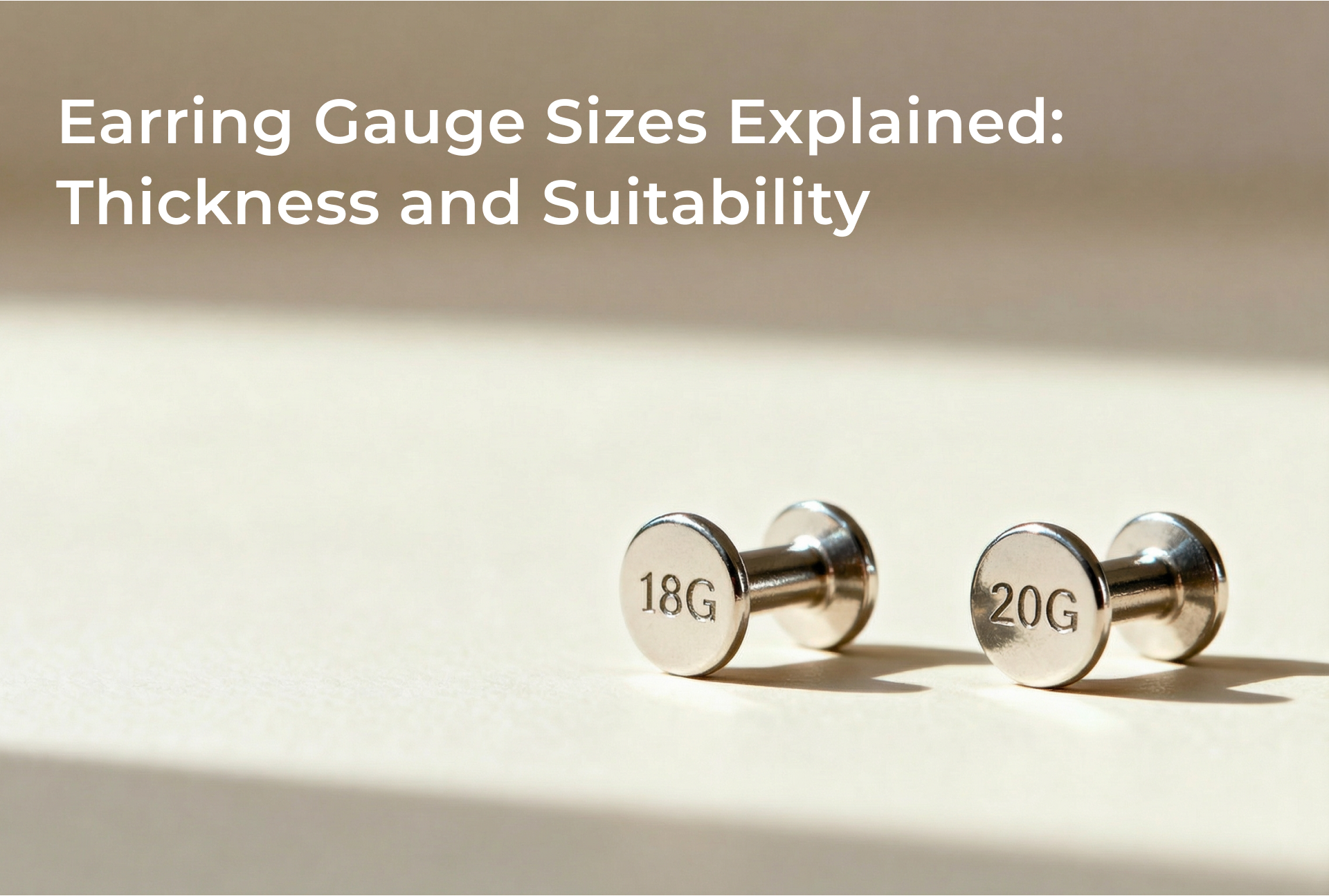
Have you ever gone shopping for earrings or even gotten pierced and come across something like “18G” or “20G” and thought to yourself, what does this really mean? Are normal earrings 18G or 20G? Well, the answer is it depends on what type of piercing you have, the kind of jewellery you are getting, and even where you got pierced.
In this blog, we will delve into the nitty-gritty of gauge sizes, why they are important for your earrings, and how to select the correct one for comfort, fashion, and healing. You will be a pro at working with earring gauges by the end of it, whether you are just starting out or are a jewellery fan.
Gauge measurement can be puzzling initially because it is opposite: the higher the number, the thinner the piece of jewellery. It began in wire production, where the gauge number represents the number of times the wire has passed through a die to reduce its thickness. In body jewellery, such as earrings, gauge (or “G” for short) refers to the thickness of the post or wire that passes through your piercing. As an example, a 20G earring is smaller in width than an 18G one. That is important because an improper gauge may influence healing, comfort, and even the likelihood of irritation or migration (when the piercing moves out of place over time).
Let us get a little more into what gauge size really is and why it matters for everyone who wears earrings.
What Is Gauge Size for Earrings?

The gauge size at its most basic is the diameter of the jewellery post or shaft—the bit that goes through your earlobe or cartilage. It is measured in gauges, and standard sizes for earrings go from 22G (very thin, around 0.6mm) to 14G (a bit thicker, around 1.6mm). The most important thing to note is that the scale is reversed: as the gauge number goes up, the thickness goes down. So a 20G post is about 0.8mm thick, whereas an 18G is 1.0mm, and a 16G shoots up to 1.2mm.
This system is not merely random; it has real-world consequences. Thinner gauges such as 20G tend to be utilized for first-time piercings because they are less invasive and easier to drive in, particularly with piercing guns readily available at malls or jewellery stores. Professional piercers at tattoo parlors generally opt for needles and begin with slightly thicker gauges such as 18G or 16G for improved healing because they form a more secure channel in the tissue.
Common Earring Gauge Sizes:

To put it all into perspective, here is an easy earring gauge size chart highlighting the most common sizes. Keep in mind that these are rough conversions:
| Gauge Size | Thickness (mm) | Thickness (inches) | Common Uses |
|---|---|---|---|
| 22G | 0.6mm | 0.025 | Extremely delicate earrings, used very seldom for first-time piercings |
| 20G | 0.8mm | 0.032 | Earlobe piercings, hoops, studs |
| 18G | 1.0mm | 0.040 | Cartilage piercings, some earlobes, nose rings |
| 16G | 1.2mm | 0.051 | Thicker earlobes, helix, tragus |
| 14G | 1.6mm | 0.064 | Industrial bars, navel, larger cartilage |
This chart is using standard industry metrics. For earlobes, 20G and 18G are prevalent because they are suitable and readily found. Piercings on cartilage, such as the helix or tragus, tend to begin at 18G or 16G because the tissue is thicker and requires more stability.
If you are not sure what gauge your piercing is, you can take it in to be measured with a caliper or go to see a piercer. A lot of people think that all earrings are standard, but they are not—the wrong gauges will be uncomfortable or worse, reject the jewellery.
18G vs. 20G: Breaking Down the Differences

And finally, to the crux of the matter: Are earrings usually 18G or 20G? Both are used, but 20G is generally the “default” for simple earlobe piercings, particularly those done with a gun. It is smaller (0.8mm), which suits dainty studs and daily wear.
Alternatively, 18G (1.0mm) is a hair thicker and preferred by pros due to its strength. It is not uncommon for cartilage or if you desire jewellery that can tolerate more weight without bending. The difference may be small—only 0.2mm—but it can be perceivable. A 20G may insert more easily but may irritate sensitive skin if it is too weak, while 18G provides more support but may need a little more pressure to get in to begin with.
Pros of 20G:
- More comfortable on new piercings.
- Greater range of dainty styles.
- Less painful to pierce (with guns).
Cons of 20G:
- At risk of migration or tearing with heavy earrings.
- Might not fit older or stretched piercings.
Pros of 18G:
- More stable and stronger for healing.
- Suits active lifestyles or cartilage.
- Minimizes risk of allergic reactions if made of good materials.
Cons of 18G:
- Slightly thicker feel.
- Less choice in super-skinny designs.
Ultimately, neither is “better”—it depends on your piercing type and preferences. If your ears were pierced years ago, they might have stretched naturally to accommodate 18G even if started at 20G.
How to Choose the Right Gauge Size
18G, 20G, or others: the decision is based on a few things. Know your piercing first: Earlobes? 20G or 18G for you. Cartilage? 18G or thicker is where you stay. Think about your lifestyle—if you are an athlete, thicker gauges do not get snagged. For looks, thinner gauges are for delicate appearances, and thicker ones for making a statement.
Material matters too: Opt for hypoallergenic options like surgical steel, titanium, or gold to avoid irritation, regardless of gauge.
Remember, forcing the wrong size can lead to infections or scarring.
Caring for Your Piercings Based on Gauge

Proper care ensures your earrings last. For new piercings, clean twice daily with saline solution. Thinner gauges like 20G heal faster (4-6 weeks for lobes) but watch for signs of irritation. Thicker 18G might take longer but are more resilient. Avoid sleeping on new piercings, and do not change jewellery too soon. If switching gauges, do it gradually to prevent damage.
In short, 18G or 20G earrings is not a blanket response—both are essentials, with 20G being the more popular choice for beginners and 18G for strength. Knowing gauge gives you the power to make educated decisions for style and wellness.
FAQs
Q1. What is a typical gauge for earlobe earrings?
A1. Most typical earlobe piercings are 20G (0.8mm), especially if pierced with a piercing gun, but professional needle piercings usually use 18G (1.0mm) for greater stability.
Q2. Is 18G thicker than 20G?
A2. Yes, 18G is thicker (1.0mm) than 20G (0.8mm). Remember, lower gauge numbers mean thicker jewellery.
Q3. Can I wear 18G earrings with a 20G piercing?
A3. It might be tight initially, but certain piercings have some give. Have a piercer to avoid damage.
Q4. How do I calculate my earring gauge?
A4. Check the post diameter with an electronic caliper, or visit a professional piercer for a proper assessment.
Q5. Does gauge size have any effect on healing time?
A5. Those thinner gauges like 20G may heal faster with less tissue loss, but the thicker ones like 18G provide more stability and this decreases complications.
Leave a Reply