

By Satyam, BlueStone Editorial
Stackable rings represent one of the most versatile and expressive personal style movements in modern fine jewellery. Rather than wearing a single standalone band, ring stacking allows you to curate an evolving combination of textures, contours, precious metals, and diamond accents across a single finger or multiple hands. In 2026, thoughtful jewellery buyers in India are moving away from rigid bridal sets toward modular, tactile gold stackable rings that adapt seamlessly from Monday boardrooms to weekend festive celebrations.
However, curating a harmonious ring stack requires more than sliding random bands onto one finger. Without understanding band profile heights, metal hardness differences, and proportional width physics, adjacent rings can grind against each other, chip delicate diamond girdles, or feel uncomfortably tight across your knuckle. This comprehensive buying guide unpacks the four golden rules of ring proportions, 18K versus 14K gold durability, precision multi-band sizing secrets, and curated styling formulas designed to help you build an enduring, comfortable fine jewellery stack.
Quick Buying Summary:
- Purity Choice: Select 18K gold (750 hallmarked) for premium lustre and richer warm tone, or 14K gold (585 hallmarked) for enhanced scratch resistance against daily metal-on-metal friction.
- The Sizing Physics Rule: Stacks wider than 4mm to 5mm occupy more vertical phalanx space. Size up by 0.5 to 1 full Indian ring size for upper or wide middle bands to prevent constriction and skin irritation.
- Setting Protection: Choose channel, bezel, or flush-set diamond bands when stacking against a raised prong solitaire to eliminate stone-girdle clashing and prong wear.
- Proportion and Texture Balance: Establish one clear anchor ring (a solitaire, gemstone, or distinct focal silhouette), then flank it with contrasting slim bands (twisted rope, milgrain, or knife-edge contours).
- Hallmark Authenticity: Ensure every individual band carries the mandatory Bureau of Indian Standards (BIS) triangular hallmark stamp and a unique 6-digit alphanumeric HUID code.
What Are Stackable Rings and Why Are They Trending in 2026?
Stackable rings are slim, modular fine jewellery bands designed to sit comfortably together on the same finger, nesting or contrasting in silhouette to form a unified aesthetic statement. While traditional Indian rings were historically designed as heavy, ornate solitary pieces reserved for ceremonial occasions, modern fine jewellery lovers prioritize daily wearable luxury that tells a personal story. Each band in a curated stack can commemorate an anniversary, an individual milestone, a career achievement, or simply an intuitive love for minimalist geometry.
In 2026, the resurgence of gold stackable rings reflects a broader shift toward versatile fine jewellery. With contemporary workwear evolving into smart-casual silhouettes and festive dressing embracing sleek sophistication, modular stacking provides infinite styling flexibility. A single stackable band delivers understated elegance for daily computer work, while layering three coordinating bands instantly transforms your hands for an evening cocktail or festive family dinner. Furthermore, stackable rings eliminate the fear of jewellery obsolescence: every new band you acquire revitalizes and recontextualizes the rings you already treasure.
How to Stack Rings: The 4 Core Rules of Proportion and Balance
Mastering how to stack rings is both an art of aesthetic balance and a discipline of physical ergonomics. When multiple metal rings occupy the limited space between your palm and your middle knuckle, adhering to four core styling principles ensures your hands look intentionally curated rather than haphazardly cluttered.
Rule 1: Choose a Defined Anchor Band
Every compelling ring stack begins with an anchor piece that commands visual authority. This anchor can be an engagement solitaire, a vibrant colored gemstone ring, a signet band, or a distinctive multi-tier highway band. Once your anchor is positioned, every secondary band acts as an intentional supporting element, framing and elevating the central focal point rather than competing for dominance.
Rule 2: Vary Band Thickness and Textures
Monotony is the enemy of an eye-catching stack. Stacking three identical plain flat bands often looks like a single heavy pipe. Instead, introduce textural variety: pair a high-polish knife-edge band with a delicate rope twist, a beaded milgrain border, or a micro-pave diamond eternity ring. The subtle interplay between polished gold surfaces, light-catching facets, and tactile contours gives the stack dimensional rhythm.
Rule 3: Coordinate Profile Heights and Contours
Profile height refers to how tall a ring rises above the surface of your skin. If you pair a low-profile flat band next to a tall, high-basket prong setting, a noticeable gap appears, and the sharp prongs may constantly scratch the neighbouring band. For rings with protruding stones, choose contoured chevron or curved bands that curve around the basket, ensuring the rings sit flush against each other with zero awkward gaps.
Rule 4: Create Negative Space Across Both Hands
Restraint is essential when styling fine jewellery. If you wear an elaborate three-band stack on your left ring finger, leave the adjacent index or pinky finger bare or accent it with an ultra-thin whisper band. Balance the visual weight across both hands: an asymmetric arrangement, such as a multi-band stack on one hand paired with a solitary thumb or index ring on the other, creates effortless contemporary sophistication.
Gold Purity Breakdown: 18K vs 14K for Daily Gold Stackable Rings
When shopping for gold stackable rings, metal purity is the single most critical factor dictating long-term durability, colour richness, and structural integrity. Because stacked rings constantly rub, slide, and touch against one another during typing, driving, and hand movements, the choice between 18K, 14K, and 22K gold carries practical lifestyle implications.
Here is how the primary gold purities compare for daily multi-band stacking:
- 18K Gold (75.0% Pure Gold: 750 Hallmark): 18 karat gold strikes the premier balance between rich, opulent gold colour and dependable strength. Formulated with 75% pure gold alloyed with copper, silver, and zinc, 18K provides the authentic warm yellow or blushing rose radiance that fine jewellery collectors revere. It is strong enough for daily wear while maintaining substantial gold value.
- 14K Gold (58.5% Pure Gold: 585 Hallmark): Containing 58.5% pure gold and 41.5% durable alloys, 14 karat gold is substantially harder and more scratch-resistant than 18K. For rings subjected to intense daily metal friction, sports, or active lifestyle wear, 14K offers exceptional prong rigidity and long-lasting surface resilience at an accessible entry point.
- 22K Gold (91.6% Pure Gold: 916 Hallmark): While 22K gold remains traditional in bridal sets, its high pure gold content makes it naturally ductile and soft. When worn as slim stackable rings, 22K bands can warp out of round, flatten under grip pressure, or loosen delicate micro-pave stone prongs. For stacked bands thinner than 2mm, 18K and 14K are universally recommended by master jewellers.
Every authentic gold ring purchased in India must carry three compulsory BIS hallmark laser stamps: the triangular Bureau of Indian Standards logo, the purity grade mark (750 for 18K or 585 for 14K), and the unique 6-character alphanumeric HUID (Hallmark Unique Identification). You can independently verify this code through the BIS Care mobile application before completing your purchase.
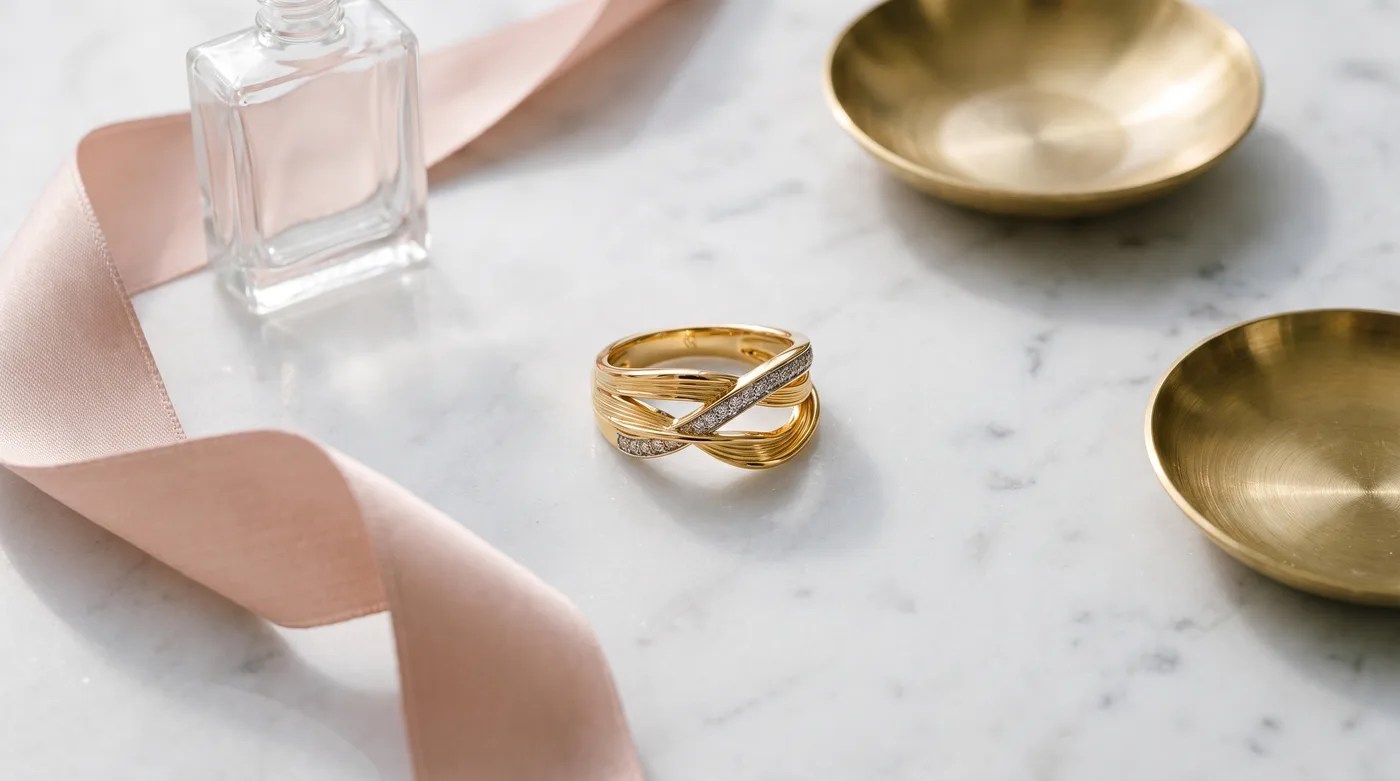
Sizing Secrets: How to Calculate Ring Size for Multi-Band Finger Stacks
A frequent mistake when investing in stackable gold rings for women is ordering every band in your standard single-ring size. In reality, ring sizing physics change dramatically when you slide multiple rings onto one finger.
A single 1.5mm band rests comfortably on the narrowest dip of your finger. However, when you stack three 1.5mm to 2mm bands together, the combined width spans 4.5mm to 6mm. As a ring stack encroaches toward the knuckle, the finger naturally thickens. A stack that is too tight restricts blood circulation, leaves red indentations, traps moisture, and causes skin chafing.
The Jeweller Sizing Rule for Ring Stacks:
- 1 to 2 Slim Bands (Under 3.5mm total width): Order your exact standard Indian ring size. The natural flexibility of skin accommodates this width with ease.
- 3 or More Slim Bands (4mm to 6mm total width): Keep your bottom base band at your exact size, but size up by 0.5 Indian size for the middle and top bands to ensure smooth knuckle passage and all-day comfort.
- Wide or Solid Multi-Row Highway Rings (Over 6mm width): Size up by one full Indian ring size. Because wide metal bands cannot displace skin sideways, they require extra internal diameter to glide smoothly over your knuckle joint.
- Knuckle vs Base Finger Discrepancy: If your knuckles are prominent, size the bands to clear the knuckle firmly with slight resistance. Once past the joint, use a slightly snug base ring to keep the stack anchored in place.
Curated Stackable Gold Rings for Women: 4 Signature Styling Formulas
Building an intentional ring stack does not require trial and error. Whether you prefer clean modern lines or opulent festive sparkle, these four tested styling formulas offer foolproof starting points for stackable gold rings for women.
Formula 1: The Modern Minimalist Trio
This everyday formula is feather-light and ideal for professional environments. Combine an ultra-fine high-polish knife-edge band, a delicate twisted gold band, and a single flush-set diamond eternity band. The subtle variance in light reflection creates texture without adding unnecessary bulk, making it comfortable for typing and continuous daily wear.
Formula 2: The Chevron Crown Nest
Designed to accentuate solitaires and oval gemstone rings, this pairing uses a V-shaped or curved chevron band positioned directly above or below the central gemstone. The contour of the chevron acts like an architectural crown, hugging the curves of the stone while extending the vertical lines of your finger for an elongated, slenderizing silhouette.
Formula 3: The Tri-Color Mixed Metal Stack
Gone are the outdated rules dictating that all jewellery on one hand must be the exact same metal colour. Stacking 18K yellow gold, blushing rose gold, and rhodium-plated white gold creates an opulent, multidimensional look. Keep the widths consistent across all three bands so the tonal shift between warm, blush, and cool metal remains the hero of the stack.
Formula 4: The Textured Highway Statement
For special occasions and festive celebrations, pair a bold multi-strand highway ring with a contrasting channel-set diamond band. Highway bands feature interconnected overlapping tiers that mimic the look of multiple stacked rings on a single comfortable shank. Adding an external chevron or twist band amplifies the architectural drama with zero risk of slipping.

Curated Design Highlights: Iconic BlueStone Rings for Everyday Stacking
To help you curate your personal stack, our design team has selected six iconic BlueStone rings. Each piece is crafted in fine 18K gold and hallmarked to perfection, engineered specifically to combine seamlessly with complementary bands or shine as a standalone statement.
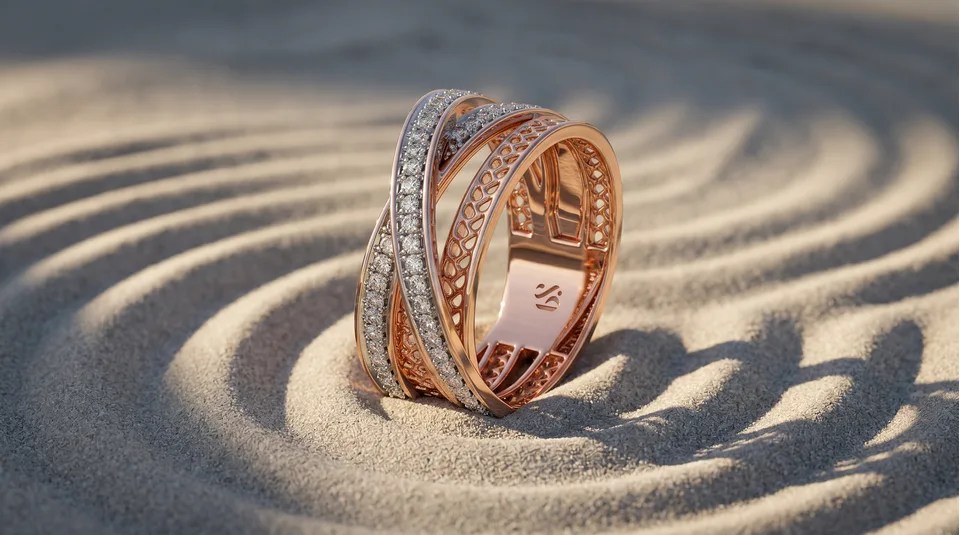
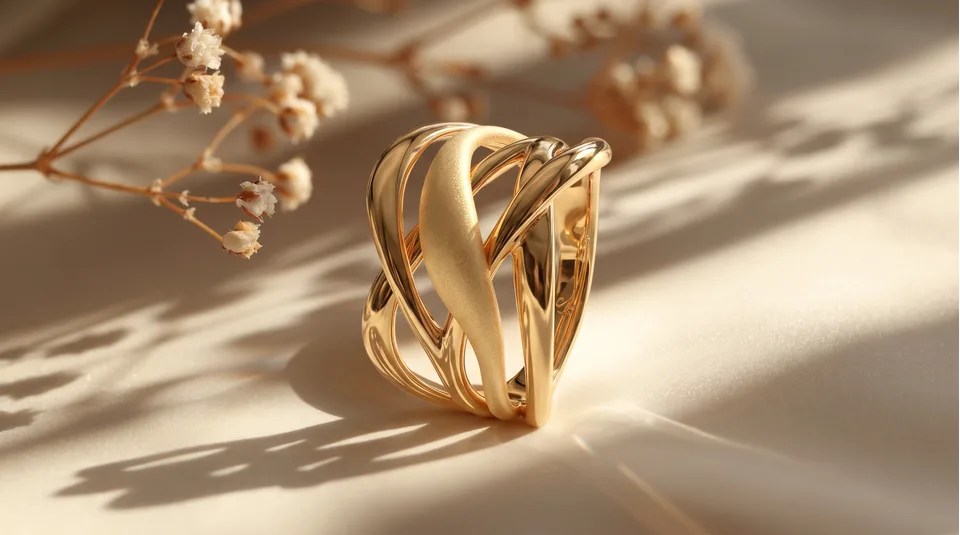
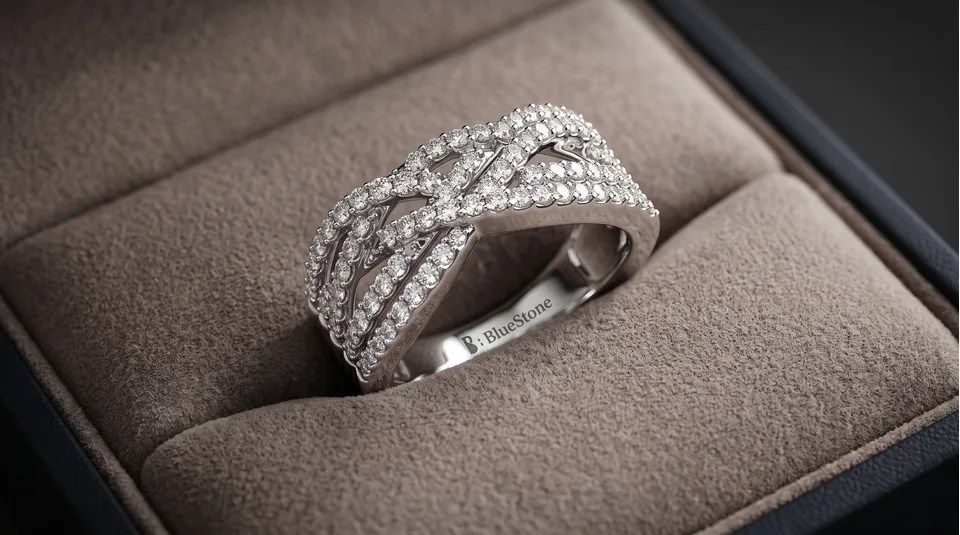

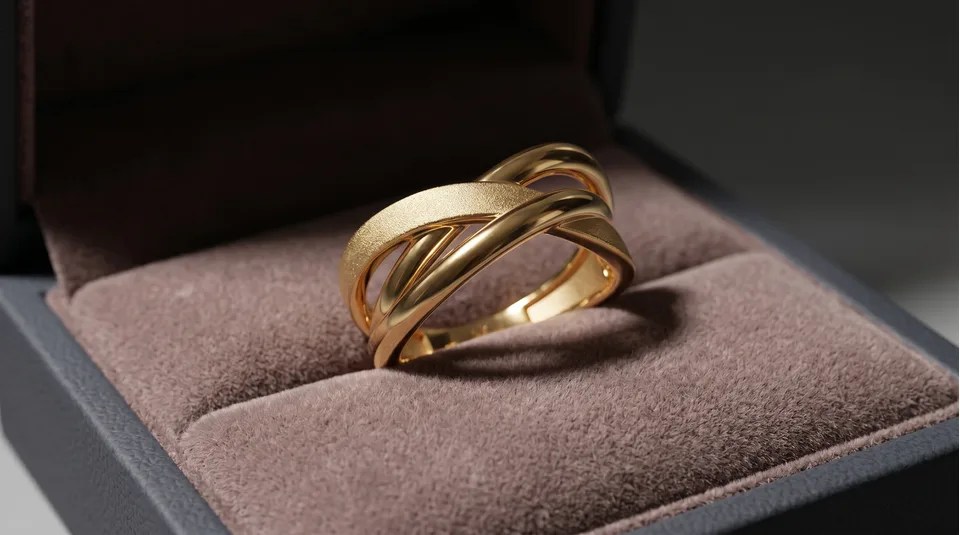

Curated Design Highlights:
- The Le Sommet Ring: An architectural V-shaped chevron band crowned with sparkling diamonds, engineered to nest perfectly beneath high-profile solitaires or create a tiara stack.
- The Haily Ring: A sculptural plain gold statement band featuring fluid organic curves, bringing rich 18K yellow gold warmth and substantial presence to any hand stack.
- The Malibu Ring: A refined, low-profile diamond band crafted for effortless daily stacking, offering continuous brilliant light with secure stone settings.
- The Viperine Twist Ring: A tactile braided rope-twist band in lustrous solid gold, ideal as a textural separator between high-polish bands or diamond eternity rings.
- The Luvee Highway Ring: A clean modern multi-strand band that creates the optical illusion of multiple layered rings on a single secure, comfortable shank.
- The Yuthika Highway Ring: An exquisite diamond-studded crossover highway silhouette delivering red-carpet brilliance and instant multi-band volume for festive evenings.
Setting Security and Stone Protection: Bezel, Channel, and Flush Bands
When rings are stacked in direct physical contact, their settings undergo continuous micro-friction. If you stack a shared-prong diamond band next to a plain polished gold band, the sharp exposed girdles of the diamonds will act like miniature glass-cutters, carving deep gouges into the neighbouring gold band over time.
To safeguard your investment and ensure decades of wear, prioritize setting styles engineered for mutual contact:
- Bezel Setting: A solid collar of gold completely surrounds each stone. Bezel edges are smooth, snag-free, and create an impermeable metal buffer between adjacent rings.
- Channel Setting: Diamonds are suspended between two parallel metal rails. Because the outer sides of the ring are solid polished gold, the stone edges never touch adjoining bands.
- Flush / Gypsy Setting: Diamonds are embedded directly into the metal band with burnished edges. The surface is entirely flat, making flush-set bands the safest companions for high-friction daily stacking.
- Low-Profile Micro-Pave: If you love claw-set diamond bands, choose micro-pave settings where prongs are rounded, polished, and recessed below the outer metal borders.
Common Ring Stacking Mistakes and How to Prevent Metal Friction
Even seasoned jewellery collectors encounter preventable pitfalls when assembling new ring stacks. Avoid these four common errors to keep your fingers comfortable and your fine jewellery pristine:
- Mixing Mismatched Metal Hardness Without Spacers: Pairing platinum directly against softer 18K or 22K gold is problematic. Platinum is denser and significantly harder than gold. Over months of friction, the harder platinum band will slowly abrade the softer gold ring. If you love mixed metal looks, insert a slim 14K spacer band or ensure metal purities are closely aligned.
- Overcrowding the Phalanx: Stacking rings so high that you cannot comfortably bend your lower finger joint leads to joint fatigue and accidental ring drops. Always leave sufficient space below the joint to permit full, natural finger articulation.
- Trapping Soap and Hand Sanitizer: Stacking multiple rings creates tight crevices where hand soaps, lotions, and alcohol-based sanitizers accumulate. This residue dulls diamond brilliance and can cause contact dermatitis. Remove your stack when washing hands or thoroughly dry your fingers before re-stacking.
- Ignoring Solder Bonding for Permanent Bridal Stacks: If you have an engagement ring and wedding band that you intend to wear together every single day without variation, consider having a trusted master jeweller tack them together with micro-soldering. This prevents metal-on-metal rotational wear entirely while keeping diamonds perfectly aligned.
Final Thoughts: Building a Timeless Gold Ring Stack with Confidence
Curating fine stackable rings is one of the most rewarding journeys in personal styling. It frees your fine jewellery from the confines of a bank locker, transforming precious 18K gold and sparkling diamonds into an intimate, daily creative canvas. By respecting proportion rules, compensating for multi-band stack width, selecting protected stone settings, and prioritizing BIS hallmarked authenticity, you create an ensemble that remains effortless, comfortable, and endlessly captivating through every chapter of your life.
More Jewellery & Buying Guides
Expand your fine jewellery expertise with our related master guides: learn how to pick the perfect solitaire in our Single Diamond Ring Buying Guide 2026, explore daily wear comfort in our Diamond Rings for Girls Buying Guide, master gold authenticity with our guide on How to Check Gold Purity in 2026, decode taxation transparently in our breakdown of GST on Gold Jewellery in India, and shop confidently with our honest review on Is Buying Gold Jewellery Online Safe in India?.
Frequently Asked Questions About Stackable Rings
How many rings can you comfortably stack on one finger?
Most people can comfortably stack two to four slim rings on a single finger. The optimal number depends entirely on the length of your finger phalanx and the individual width of each band. As a rule of thumb, the total combined width of the stack should not exceed 6mm, leaving ample breathing room below the middle knuckle joint for natural movement.
Should I size up when buying gold stackable rings?
Yes, you should size up by 0.5 to 1 full Indian ring size if you plan to wear three or more rings together or if your stack exceeds 4mm in total width. Wide stacks compress finger tissue and push against the wider base of the knuckle, making rings ordered in your exact single-band size feel excessively tight and uncomfortable.
Is 18K or 14K gold better for stackable rings?
Both 18K and 14K gold are excellent choices for stackable rings. 18K gold (750 hallmark) delivers a richer, more luminous gold colour and higher precious metal value, making it the luxury standard. 14K gold (585 hallmark) contains a higher percentage of alloy metals, providing increased surface hardness and superior scratch resistance against daily metal-on-metal friction.
Can you mix yellow, rose, and white gold in the same ring stack?
Absolutely. Mixing metals is one of the most sophisticated contemporary styling trends in fine jewellery. To ensure a cohesive aesthetic, keep the band widths or stone sizes relatively consistent across all three bands. This allows the beautiful tonal contrast between warm yellow gold, romantic rose gold, and sleek white gold to feel deliberate and harmonized.
Do stackable rings damage each other over time?
Rings can damage each other if sharp diamond girdles or protruding prongs rub directly against neighbouring plain gold bands. To prevent metal gouging and prong wear, choose bezel, channel, or flush-set diamond bands when stacking, or use a smooth contour band to create a protective buffer around raised solitaire stones.
Can stackable rings be worn on any finger?
Yes, stackable rings can be worn on any finger, including the index, middle, ring, and pinky fingers. Index and middle fingers are particularly popular for modern geometric stacks because they offer greater surface length and visual prominence. Ensure each band is individually sized for the specific finger on which you intend to wear it.


Leave a Reply