

If you’ve ever caught yourself staring at a ring because it just keeps shining, chances are you were looking at a pavé diamond setting.
A pave setting doesn’t feature a single dramatic stone or thick metal. It just gives you a soft, continuous sparkle that follows the curve of the ring. That’s a pavé setting. It doesn’t shout, but it glows quietly giving you an elegant beautiful look.
People often assume pavé rings are complicated or delicate, but the truth is simpler. Pavé setting is about using many tiny diamonds to create one strong visual effect. Think of it like embroidery in jewellery form. Individually, each diamond is small. But what steals the spotlight is how together, they change everything in the look.
In this blog, let’s talk about what a pavé diamond setting is, why it’s so loved, and whether it actually makes sense for everyday wear.
What is a pavé diamond setting?
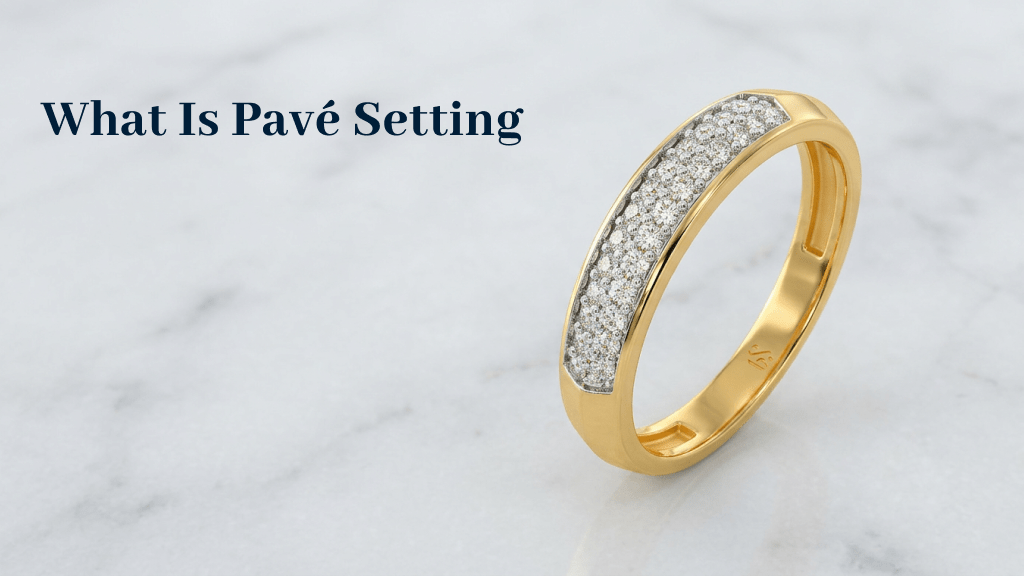
A pavé diamond setting is when small diamonds are set very close to each other along the surface of a ring. The stones are held with tiny metal beads, so tiny that you barely notice them. What you see instead is the sparkle of diamonds which makes the ring look glamorous edge to edge.
The word “pavé” comes from the idea of paving a road. Instead of stones on the ground, you have diamonds across the band. That’s why pavé diamond rings often look like they’re made of diamonds rather than metal.
You will find pave settings in engagement rings, wedding bands, and other luxury diamond ring styles where detail matters more than bulk.
Why pavé diamond rings sparkle so differently

There’s a reason why pavé rings catch your eye even in low light.
With pavé diamond rings, light doesn’t hit one stone and stop. It bounces, moves and travels across dozens of tiny diamonds.
That’s why pavé setting is always mentioned when people talk about sparkle-heavy settings.
Pavé diamond rings do not give you a sharp flash like a solitaire. It’s more like a steady glow. It’s elegant, constant and almost soft, but it’s still noticeable enough to steal the spotlight.
That’s also why pavé bands look beautiful in photos. The sparkle of diamond spreads evenly instead of concentrating in one spot, making the ring look glamorous.
Pavé band ring or solitaire: which feels right?

A pavé band ring gives a very different feeling compared to a solitaire.
Solitaire rings are about focus. One diamond becomes the center of attraction in solitaire rings. On the other hand, pavé rings are about texture, sparkle and detailing. While some people love the simplicity of a solitaire, others want their ring to feel rich from every angle. This is the reason why they opt for a pavé ring.
Many modern designs combine both, the styles of pavé and solitaire ring. These designs feature a centre stone with a pavé band underneath. This mix is becoming popular because it balances drama and delicacy. You get a focal point and a supporting glow, both in one ring.
Micro pavé diamonds: small work, big skill

When you hear the term micro pavé diamonds, it means the diamonds are even smaller and set even closer together. From a distance, micro pavé diamonds look like a smooth shimmer rather than individual stones.
This style is common in high-end luxury diamond ring styles because it takes serious skill to execute the setting properly and beautifully.
Although micro pavé diamonds look stunning, its creation requires precise work.
The setting quality matters more in a pavé setting than almost anywhere else.
When pavé setting is done well, the ring becomes a masterpiece, but when rushed, it can later create problems for the wearer.
The real pavé setting pros and cons

Let’s be honest. We cannot call any setting perfect in every sense.
Every setting has its own pros and cons. There are many things which people genuinely love about pavé setting and some they don’t. Therefore, before choosing, you should know what are pavé setting pros and cons.
Why people choose pavé diamond settings
People often choose pavé diamond settings over other settings. Do you know why? Because the pavé setting provides many benefits.
pavé setting offers massive sparkle without a heavy look
pavé setting makes slim bands feel luxurious
pavé setting rings pairs beautifully with engagement rings
pavé setting always looks detailed and glamorous, even in simple designs
Where pavé settings need thought
Before choosing pavé setting for your ring, here are some important things that you should know well in advance:
Pavé setting needs regular cleaning
Pavé setting features tiny diamonds which mean quality matters
Pavé setting is not ideal for very rough use
These pavé setting pros and cons aren’t deal-breakers. They’re just things to know before falling in love with the shine of this beautiful setting.
Can you wear a pavé diamond setting every day?
This question comes up a lot, and the honest answer is yes. You can wear a pavé diamond setting ring every day but with awareness.
A well-made pavé diamond setting ring is absolutely suitable for daily wear. Most modern pavé rings are designed for real life, not display cases.
But usually pavé rings don’t enjoy being knocked around. If your day involves heavy lifting, gym work, or constant impact, it’s better to remove the pavé diamond setting ring during those moments to avoid any damage. Think of it like a silk saree. Strong, beautiful, but deserving of care.
Why pavé feels so modern right now
There’s a reason why pavé settings keep showing up in new collections.
Today’s jewellery trends lean toward refined detail rather than weight. Pavé setting fits perfectly into that shift. It adds richness without bulk. Sparkle without heaviness.
That’s why you’ll see pavé paired with oval diamonds, elongated shapes, and clean silhouettes. It’s one of the most versatile sparkle-heavy settings available.
Pavé compared to other sparkle-heavy settings
If you’re choosing between pavé, halo, or channel settings, think about how you want the sparkle of your jewellery to behave.
Halo settings highlight the centre stone of the ring.
Channel settings feel structured and organized visually.
Pavé setting spreads the sparkle across the entire ring.
If you like rings that quietly shine all the time and you prefer sparkle-heavy settings, then you can opt for pavé diamond rings because they usually feel the most satisfying in terms of balanced sparkle and elegance for long-term use.
Final thoughts
A pavé diamond setting isn’t about one dramatic moment. It’s about consistency. It’s about a ring that looks beautiful in sunlight, restaurant lighting, and everyday life.
If you love jewellery that rewards close attention and feels rich without being loud, choosing pavé setting makes sense. Just choose good craftsmanship, wear it mindfully, and let the sparkle do its quiet work.
FAQs
What is a pavé diamond setting in simple words?
A Pavé diamond setting is a setting where small diamonds are placed close together for continuous sparkle.
Are pavé diamond rings high maintenance?
pavé diamond rings are not really high maintenance, but they do need regular cleaning and gentle care.
What are the main pavé setting pros and cons?
The pros of the pavé setting are that they provide a beautiful sparkle and luxury feel. Cons include extra care and cleaning.
Do micro pavé diamonds fall out easily?
micro pavé diamonds usually do not fall out easily, but if the setting is poorly made or handled roughly then it can happen.
Are pavé diamond rings good for engagement rings?
Yes, pavé diamond rings can be one of the perfect choices for engagement rings because they’re one of the most popular sparkle-heavy settings today, suitable for special events.
Related Blogs
- Pendant Necklace Inspiration: Diamond, Pearl, Rose Gold & Cross Designs You’ll Adore
- What Is a Bezel Setting in Diamond Rings? Should You Consider It for an Engagement Ring?
- Prong Setting Explained: Why It’s the Most Popular Diamond Setting
- Halo Setting Explained: Does It Really Make Diamonds Look Bigger?


Leave a Reply