
Ever been left grasping a glittering gem and questioning whether it’s the real thing? You’re not the only one! Diamonds are the jewellery industry’s rock stars, but with cubic zirconia and moissanite knockoffs galore, determining real diamond identification can be like searching for buried treasure. Whether you’re looking at an engagement ring or viewing Grandma’s antique, being able to tell a real diamond from a fake is essential to avoid making an expensive mistake. Here in this guide, we’ll offer simple, expert advice and diamond tests you can do at home or with the help of an expert.
Why Knowing a Real Diamond Matters
Picture this: You see a glittering “diamond” ring at a bazaar for pennies on the dollar. Your heart leaps, but your head is saying, “Is it real?” That’s where genuine diamond identification comes to the rescue. Genuine diamonds are created far below the earth’s surface, so they’re scarce and costly. Imitations? They’re usually artificially crafted duplicates that don’t pay in value or endurance.
Diamonds are the hardest natural material, with a 10 on the Mohs scale. They also refract light in a manner that produces that classic glint. But how do you identify one without a gemology PhD?
Begin with the golden rule: always request a certificate from a reputable lab such as GIA (Gemological Institute of America) or AGS (American Gem Society). These reports verify the authenticity of the diamond and specify its 4Cs – cut, colour, clarity, and carat. If the jewellery doesn’t comply, that’s a red flag!
Some Fast Visual Inspections for Diamond Testing
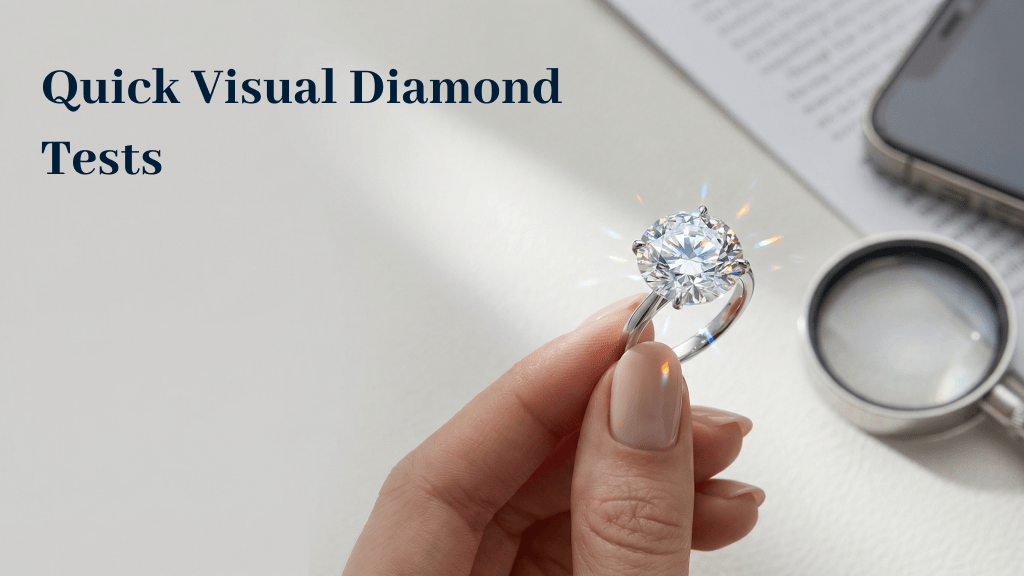
Let us begin with some of the tricks of diamond testing that you can perform using simply your eyes and light. First, observe the sparkle. Genuine diamonds disperse light into rainbow colours, referred to as dispersion. Shine it under a lamp, and if you notice primarily grey or white sparkles, it could be glass or imitation.
Next, check the edges. Diamonds have clean, sharp facets since they’re extremely hard. Fakes such as cubic zirconia have rounded or worn-out edges. Get a magnifying glass (or your smartphone’s zoom) to examine in more detail. Real diamonds typically contain small natural imperfections, known as inclusions. If it’s too flawless and very inexpensive, it’s more likely to not be genuine.
Here’s a playful one: the newspaper test. Set a loose diamond face down over some words. If you can see the words behind it, chances are it’s a fake. Genuine diamonds refract light so intensely that the words become blurry. I did this with a friend’s ring one time, and well…suffice to say, we could read the whole thing. Not a very happy day. But hey! At least we know that these tests work 😉
Simple Home Tests for Identifying Real Diamonds

You don’t require a lab for some good diamond testing. Test these at home! The fog test is a popular one: breathe onto the diamond as if fogging a window. A real diamond instantly defogs because it transfers heat like a pro. Fakes remain fogged for a second or two. However, moissanite may pass this, so use it as a combination test.
The water test is also a treasure. Submerge a free diamond in a glass of water. Natural ones are heavy and will sink straight to the bottom. Fakes that are lighter may float or slowly sink. Just don’t drop it down the drain!
Got a black light? Use the UV test. Shine a UV light in a dark room onto the diamond. Most genuine ones fluoresce blue, but roughly 30% won’t, so this is not infallible. If it glows green or yellow, chances are it is not a diamond. These methods are simple and enjoyable ways to begin your real diamond discovery process.
Pro-Level Diamond Testing Tools
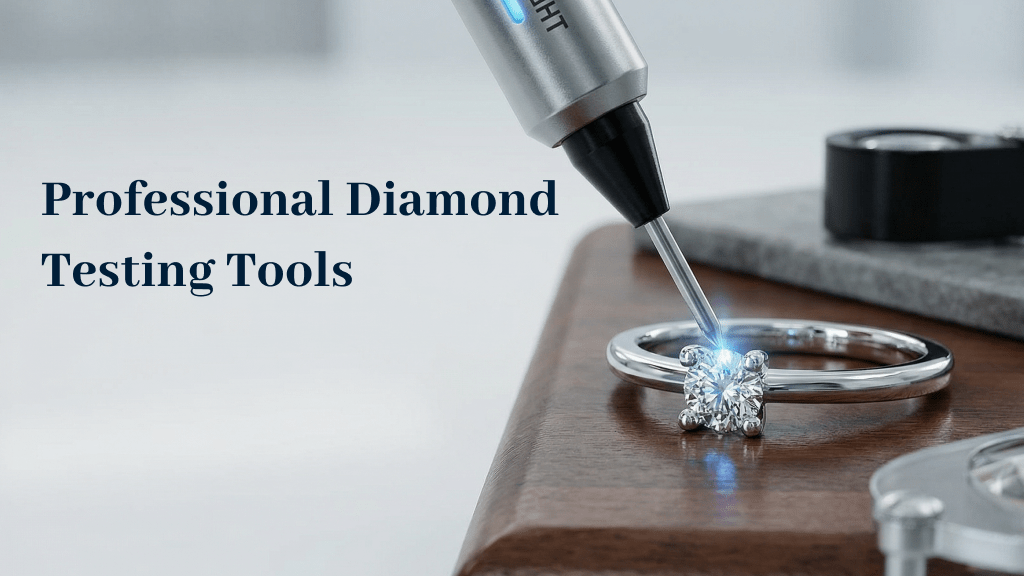
Other times, home tests just won’t cut it, particularly for costly stones. That’s when the professionals take over. Jewellers utilise a thermal conductivity tester, a tiny device that tests how quickly heat travels through the stone. Genuine diamonds transfer heat well, so the tester beeps or glows. You can find a simple one online for around $20, but if you’re serious about real diamond detection, see a gemologist.
Another pro instrument is the refractometer, which detects the way light bends. Diamonds possess a special refractive index of 2.42, which is greater than that of most impostors. Lab-created diamonds may pass these examinations, so enquire about origin if that is important to you.
I once brought a ring to a jeweller who had a tester; it glowed green for diamond! That instant verification was such a relief. Professionals have the equipment and expertise to get it right on how to recognise a real diamond.
Spotting Common Diamond Fakes

To master real diamond identification, know what you’re up against. Cubic zirconia (CZ) is the top impostor…it is shiny but soft, and it scratches easily. Moissanite is trickier; it’s hard and sparkly but shows double refraction under a loupe (you’ll see doubled edges). Glass is a dead giveaway; it chips and lacks fire. White sapphires are natural but less brilliant.
Lab diamonds are actual diamonds, only produced in a lab and at a lower cost. To avoid cons, purchase from reputable jewellers or stores with straightforward return policies. If something sounds too good to be true, it most likely is.
Final Thoughts: Be a Diamond Detective
There you go! A complete toolbox for authentic diamond identification! From simple home tests to expert-level devices, you’re set to identify a real diamond and skip the fakes. Whether shopping for bling or inspecting an heirloom, these tips make identifying a real diamond so much simpler. Stay curious, stay smart, and keep sparkling!
FAQs
What’s the easiest way to do real diamond identification at home?
The fog test is simple and fast: exhale on the diamond, and a true one instantly disperses fog because of its heat conductivity.
How can I determine if my diamond is natural or lab-grown?
Both are actual diamonds, but natural ones tend to have distinct inclusions. A gemologist can utilise sophisticated equipment for diamond testing to differentiate between them.
Can a genuine diamond scratch glass?
Yes, because diamonds are exceptionally hard. But this test can hurt the setting, so it’s not optimal for knowing an authentic diamond.
Why do certain diamonds glow under ultraviolet light?
Certain diamonds glow blue because of trace elements. It’s an interesting clue for testing diamonds, but not all genuine diamonds glow.
Can moissanite deceive diamond tests?
It can pass some, such as the fog test, but a loupe detects its double refraction. Pro tools are ideal for precise real diamond identification.
Related Blogs
Leave a Reply