
By Satyam, BlueStone Editorial
Fine gemstone jewellery brings vibrant personality, rich cultural heritage, and expressive colour into fine gold artistry. Whether you are captivated by the royal crimson of natural ruby, the velvet depths of blue sapphire, the lush verdant glow of emerald, or contemporary semi-precious accents like amethyst, topaz, and citrine, purchasing coloured gemstone jewelry in India requires specialized knowledge beyond standard plain gold shopping. In this comprehensive 2026 buying guide, we explore the essential pillars of selecting authentic gemstone jewellery: mineral hardness and durability, precious versus semi-precious classifications, setting security, gold purity pairing, BIS hallmarking standards, and transparent invoice accounting.
Quick Summary for Gemstone Buyers in 2026:
- Daily Wear Durability: For everyday rings and bracelets subjected to daily contact, prioritize gemstones with a Mohs hardness of 8 to 9, such as ruby and sapphire. Softer stones like emerald (7.5 to 8), tanzanite (6.5 to 7), or opal (5.5 to 6.5) perform best in protective bezel settings, pendants, or occasion earrings.
- Ideal Metal Purity: 18K and 14K solid gold provide optimal prong rigidity and tensile strength to lock gemstones securely in place. Soft 22K gold is generally unsuitable for intricate stone settings because pliable prongs can loosen over time.
- Mandatory Invoice Transparency: Always demand an itemized invoice that clearly separates the gross weight, gemstone carat weight, and net gold weight. Under Indian consumer protection standards, you must only pay the gold rate on the net gold weight, never on the combined gross weight of the jewellery.
- Certification and Hallmarking: Verify the 6-digit alphanumeric HUID stamped on the gold via the official BIS CARE app, and ensure coloured gemstones and diamonds carry authentic certification from recognized gemmological laboratories such as SGL, IGI, or GIA.


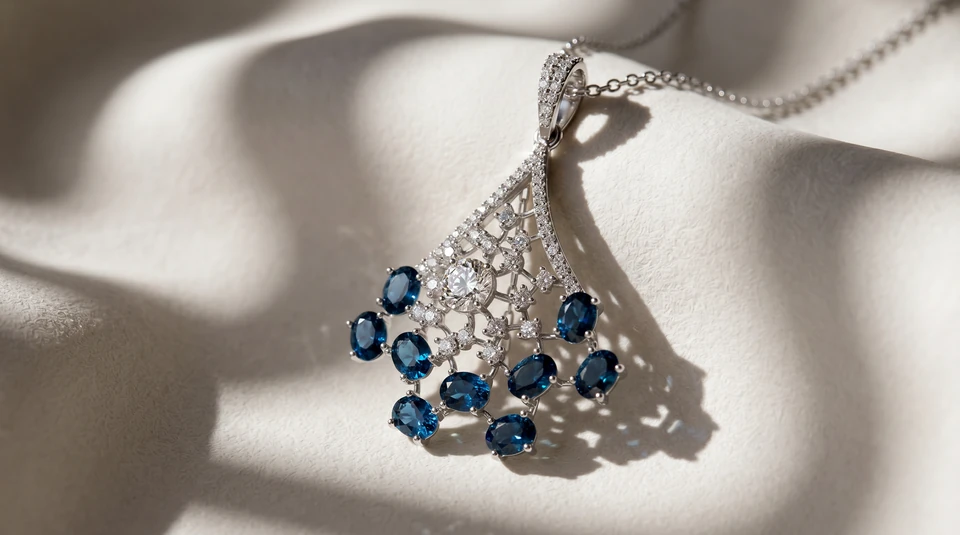
Curated Design Highlights: Discover handcrafted fine gemstone silhouettes engineered for vibrant optical fire: The Sarvanya Pendant featuring vivid blue stone cluster radiance, The Teshvarya Pendant with warm halo gem framing, The Thaloria Pendant set in solid 18k yellow gold, The Lumeelle Cluster Pendant with multifaceted brilliance, The Aagarna Pendant showcasing delicate drop contours, and The Valeria Rose Pendant for refined everyday luxury.
What Is Fine Gemstone Jewellery: Precious vs Semi-Precious Classification
Gemstone jewellery refers to fine ornaments crafted in precious metals like gold and platinum that prominently feature natural, faceted, or cabochon cut mineral crystals. Historically, the jewellery trade categorized gemstones into two broad groups: precious stones and semi-precious stones. Understanding this distinction helps buyers appreciate how market value, scarcity, and physical attributes influence gemstone jewellery designs.
The term precious gemstone traditionally refers to the “Big Four”: diamond, ruby (corundum), blue sapphire (corundum), and emerald (beryl). These stones have historically commanded the highest prestige and value due to their extraordinary hardness, brilliance, rich color saturation, and historical royal patronage. In fine Indian jewellery, precious gemstones have anchored ceremonial heirlooms, royal coronation ornaments, and bridal wedding sets for generations.
The term semi-precious gemstone encompasses all other natural gem minerals. This diverse group includes vibrant stones such as blue topaz, amethyst, garnet, citrine, peridot, tourmaline, aquamarine, tanzanite, and organic gems like natural pearl. Modern gemmologists emphasize that the label “semi-precious” is somewhat misleading; exceptional specimens of tsavorite garnet, Paraiba tourmaline, or untreated imperial topaz can command per-carat prices that rival or exceed commercial-grade rubies and sapphires. In modern gemstone jewelry, semi-precious stones allow master designers to create expressive, wearable, and accessible luxury pieces in striking hues.

Understanding Gemstone Durability: The Mohs Hardness Scale for Daily Wear
When selecting gemstone jewellery designs, visual charm must be balanced against mechanical durability. A gemstone’s longevity depends on three distinct factors: hardness (resistance to surface scratching), toughness (resistance to chipping or cracking under impact), and stability (resistance to heat, light, and household chemicals). The primary benchmark used worldwide is the Mohs Scale of Mineral Hardness, which rates minerals from 1 (talc) to 10 (diamond).
Because household dust particles contain quartz crystals with a Mohs rating of 7, any gemstone softer than 7 will gradually accumulate microscopic scratches over years of unprotected daily friction. Here is how popular jewellery gemstones rank across the durability spectrum:
- Diamond (Mohs 10): The hardest known natural substance. Impervious to daily abrasion and suitable for permanent, lifetime daily wear across rings, bracelets, and necklaces.
- Corundum: Ruby and Sapphire (Mohs 9): Exceptionally hard and tough. Excellent resistance to scratching and chipping. Highly recommended for daily wear engagement rings, cocktail bands, and daily wear bracelets.
- Chrysoberyl and Alexandrite (Mohs 8.5): Highly durable with outstanding toughness, making them superb for heirloom rings and fine pendants.
- Topaz and Spinel (Mohs 8): Very good hardness for regular wear. Topaz possesses perfect basal cleavage, meaning it should be protected from sharp lateral impacts that could cleave the crystal plane.
- Beryl: Emerald and Aquamarine (Mohs 7.5 to 8): While hard enough to resist everyday dust scratching, emeralds naturally contain internal fractures and fluid inclusions known as jardin (garden). These inclusions make emeralds brittle under mechanical shock, requiring protective settings and conscious wear.
- Quartz: Amethyst and Citrine (Mohs 7): Good everyday durability. Safe for regular office wear rings and earrings, provided they are stored separately from harder diamonds and sapphires.
- Garnet and Tourmaline (Mohs 7 to 7.5): Reliable hardness with a broad spectrum of rich, warm hues. Ideal for statement pendants, drop earrings, and festive necklaces.
- Tanzanite and Peridot (Mohs 6.5 to 7): Softer gemstones sensitive to thermal shock and sudden pressure. Best suited for earrings, pendants, or occasion rings rather than daily impact pieces.
- Opal and Turquoise (Mohs 5.5 to 6.5): Delicate, porous gemstones vulnerable to scratching, dry air, and cleaning chemicals. Best reserved for evening wear or protective bezel mountings.
- Organic Gems: Pearl and Coral (Mohs 2.5 to 4): Very soft and chemically vulnerable. Organic gemstones react adversely to perfumes, body lotions, and hairsprays, requiring careful handling and post-wear wipe-downs.

Trending Gemstone Jewellery Designs Across Categories
Modern fine jewellers have reimagined classic motifs into versatile, contemporary silhouettes. Whether you prefer delicate minimalism for daily corporate wear or dramatic statement pieces for celebratory occasions, current 2026 gemstone jewellery designs span several distinct design categories:
- Gemstone Rings and Solitaire Bands: From classic oval-cut blue sapphire solitaire rings flanked by tapered diamond baguettes to vibrant emerald-cut cocktail rings and bezel-set birthstone bands, rings offer the most intimate way to enjoy gemstone colour. Stacking bands featuring alternating gemstones and diamonds continue to dominate modern styling.
- Gemstone Studs, Huggies, and Drop Earrings: Everyday studs set with round or princess-cut rubies, sapphires, or amethysts provide an effortless pop of sophisticated colour near the face. For festive celebrations, chandelier jhumkis and gemstone-fringed drop earrings set in solid gold create mesmerizing movement.
- Gemstone Pendants and Charm Necklaces: Single-stone gemstone pendants suspended from delicate gold chains remain an essential wardrobe staple. Protective talisman designs, such as evil-eye motifs featuring vibrant turquoise, lapis lazuli, and blue sapphire accents, blend modern aesthetics with symbolic personal protection.
- Gemstone Bracelets and Bangles: Tennis bracelets set with continuous rows of calibrated coloured gemstones, flexible chain bracelets with bezel-set gemstone charms, and solid gold hinged bangles featuring floral gemstone clusters deliver dynamic elegance on the wrist.
- Curated Multi-Gemstone Ensembles: Traditional Indian Navratna jewellery, incorporating nine sacred planetary gemstones (ruby, pearl, red coral, emerald, yellow sapphire, diamond, blue sapphire, hessonite, and cat’s eye), has been redesigned into sleek, geometric geometric cuffs, eternity rings, and delicate choker necklaces suitable for modern festive wear.
Gemstone Quality Criteria: Colour, Clarity, Cut, and Carat Weight
Evaluating coloured gemstones follows a distinct framework compared to colorless diamonds. While diamond grading prioritizes the total absence of colour, gemstone evaluation centers predominantly on the richness, beauty, and authenticity of the colour itself.
1. Colour: Hue, Tone, and Saturation: Colour is the single most influential determinant of a gemstone’s desirability and financial value. Gemmologists analyze colour through three interrelated components:
- Hue: The precise primary spectral colour of the stone (such as red, blue, or green), along with any secondary tint (such as slightly purplish-red or yellowish-green). Pure primary hues generally command higher value.
- Tone: The relative lightness or darkness of the stone on a scale from very light to very dark. Medium to medium-dark tones are generally considered optimal; stones that are too dark appear blackish and lifeless under indoor lighting, while stones that are too light lack visual presence.
- Saturation: The purity, intensity, and vividness of the colour. Stones with vivid saturation exhibit vibrant, electric colour without grayish, brownish, or muddy undertones.
2. Clarity and Inclusions: Unlike diamonds, where microscopic inclusions are penalized, coloured gemstones naturally crystallize in complex geological environments rich in mineral impurities. Gemmological science categorizes gemstones into three clarity types:
- Type I (Usually Eye-Clean): Minerals like blue topaz, aquamarine, and tanzanite naturally crystallize with minimal internal inclusions. Buyers should expect high optical clarity.
- Type II (Usually Included): Minerals like ruby, sapphire, amethyst, and garnet typically exhibit minor visible inclusions, such as silk rutile needles or microscopic liquid veils. These inclusions authenticate natural origin without degrading structural durability.
- Type III (Almost Always Included): Emeralds and red beryls invariably contain internal fissures, mineral crystals, and fluid cavities (jardin). An eye-clean natural emerald is an extreme rarity; inclusions are accepted as proof of authentic natural formation as long as they do not reach the surface or compromise durability.
3. Cut and Proportions: The cutter’s goal with coloured gemstones is to maximize colour richness and brilliance rather than adhere to rigid geometric tolerances. A well-cut gemstone exhibits even colour across the table without a large “window” (a washed-out, transparent center where light leaks through) or heavy “extinction” (dark, opaque patches). Popular cuts include brilliant-cut ovals, step-cut emerald shapes, cushion cuts, and smooth domed cabochons.
4. Carat Weight and Specific Gravity: Gemstone weight is measured in metric carats (1 carat = 0.20 grams). However, buyers must remember that different gem minerals possess different specific gravities (densities). For example, a 1-carat ruby has a higher density than a 1-carat emerald; consequently, a 1-carat emerald will physically appear noticeably larger than a 1-carat ruby of identical carat weight. In fine jewellery, setting dimensions in millimetres provide a much more accurate estimate of face-up visual size than carat weight alone.
Natural vs Synthetic and Treated Gemstones: Disclosure Rules for Buyers
The modern gemstone market includes natural mined gemstones, treated gemstones, and laboratory-grown synthetic crystals. Reputable fine jewellers adhere to strict disclosure standards so buyers make informed investments:
- Natural Untreated Gemstones: Mined directly from the earth and shaped purely by cutting and polishing without artificial enhancement. Because truly unheated, untreated rubies and sapphires represent less than one percent of total mined supply, they command substantial investment premiums.
- Traditional Heat Treatment: Heating rubies and sapphires to high temperatures is an ancient, universally accepted stable treatment that dissolves rutile silk inclusions and permanently improves clarity and colour saturation. As long as no foreign glass, flux, or coloring agent is introduced, traditional heat treatment is fully accepted in fine jewellery and should be disclosed on the certificate.
- Fracture Filling and Lead-Glass Treatments: Highly unstable treatments where low-grade stones with severe surface fissures are filled with high-refractive glass or coloured polymers. These treated stones can crack or discolour when exposed to heat during ring resizing or ultrasonic cleaning. Reputable fine jewellers strictly avoid lead-glass filled stones.
- Oil and Resin Clarity Enhancement in Emeralds: Because emeralds naturally possess open surface fissures, immersing them in colourless cedarwood oil or specialized optical resins has been standard practice for centuries to minimize light scattering. Natural oiling is fully accepted, provided the degree of enhancement (minor, moderate, or significant) is clearly certified.
- Synthetic (Lab-Grown) Gemstones: Chemically, physically, and optically identical to mined gemstones, but synthesized in controlled laboratory reactors. While lab-grown stones offer excellent colour and affordability, they must always be explicitly labelled as synthetic or lab-created and never sold under ambiguous natural trade names.
Gold Purity and Setting Security: Protecting Your Gemstones
The choice of precious metal framework is not just an aesthetic consideration; it directly determines how safely your gemstones remain anchored over decades of wear. In Indian fine jewellery, selecting between 14K, 18K, and 22K solid gold involves critical structural tradeoffs:
18K Gold (75.0% Pure Gold): 18K gold strikes the perfect golden ratio for luxury gemstone jewellery. It delivers the deep, warm prestige of genuine gold while alloyed with 25% strengthening metals (such as silver, copper, and zinc) that provide the structural rigidity required for tight prong settings and delicate pave work.
14K Gold (58.5% Pure Gold): 14K gold offers exceptional scratch resistance and superior hardness. For active individuals wearing gemstone rings or bracelets daily, 14K gold provides maximum claw grip and minimal risk of prongs bending out of alignment.
Why 22K Gold Requires Caution with Faceted Stones: While 22K gold (91.6% purity) is revered for traditional plain gold wedding jewellery, its natural softness makes it problematic for faceted gemstone settings. Slender prongs cast in 22K gold can easily deform, snag on clothing, or bend outward, causing valuable stones to dislodge. If you love 22K gold jewellery, opt for traditional Kundan-Jadau settings with 24K pure gold foil foiling rather than modern delicate prong mountings.
Setting Styles That Maximize Gemstone Security:
- Bezel Setting: A continuous collar of solid gold encases the entire perimeter of the gemstone. The bezel protects vulnerable edges and corners from lateral impacts, making it the safest setting for softer stones, active lifestyles, and snag-free daily wear.
- Prong (Claw) Setting: Four or six individual metal prongs hold the stone aloft, allowing light to enter from all angles to maximize brilliance. Prongs should be inspected annually by a professional jeweller to ensure none have worn down or bent.
- Channel Setting: Gemstones are suspended between two parallel walls of solid gold without individual prongs. This setting offers a completely smooth, flush surface ideal for tennis bracelets, eternity bands, and everyday bangles.
- Halo Setting: A central coloured gemstone is surrounded by a ring of smaller natural diamonds. In addition to creating the visual illusion of a significantly larger centerpiece, the outer halo serves as a protective bumper against accidental knocks.
- The Rapett Evil Eye Charm Necklace: A contemporary layered gold charm necklace showcasing vibrant protective gemstone medallions framed by brilliant natural diamonds.
- The Malocchio Charm Holder Bracelet: Solid 18K gold charm bracelet designed to hold colourful talisman charms, providing secure daily wrist wear.
- The Ixea Evil Eye Pendant: An elegant teardrop pendant combining intense turquoise and blue sapphire hues with a crisp diamond halo in solid gold.
- The Pear Evil Eye Toggle Bangle: A modern pear-motif hinged gold bangle featuring calibrated gemstone inlay and secure clasp engineering.
- The Zamen Nazariya Anklet: Fine solid gold anklet featuring bezel-set protective beads and subtle gemstone stations designed for lightweight daily comfort.
- The Pervinca Charm Holder Bracelet: A luxurious link bracelet in 18K yellow gold offering customizable charm links and robust claw closures.
Indian Gemstone Jewellery Buying Secrets: BIS Hallmarking, HUID and GST Invoices
Purchasing fine jewellery in India requires navigating government consumer protection regulations and strict billing standards. Knowing your legal rights ensures you never overpay or fall victim to outdated trade practices:
The Mandatory BIS 6-Digit Alphanumeric HUID: Under Bureau of Indian Standards (BIS) regulations, every piece of gold jewellery sold in certified Indian retail must carry three mandatory laser stamps: the triangular BIS hallmark logo, the purity mark (such as 750 for 18K gold, 585 for 14K, or 916 for 22K), and a unique 6-digit alphanumeric Hallmark Unique Identification (HUID) code. You can download the official BIS CARE mobile application, input the 6-digit HUID code, and instantly verify the hallmarking center, testing date, jeweller registration, and exact gold purity.
Itemized Invoice Rule: Gross Weight vs Net Weight: In unorganized jewellery markets, unscrupulous retailers sometimes weigh the entire gemstone piece and multiply the combined gross weight by the prevailing gold rate. This unfair practice results in consumers paying gold rates for gemstones that cost significantly less per gram!
By Indian law and fair trading standards, your jewellery invoice must strictly itemize:
- Gross Weight: The total combined weight of the finished jewellery item including metal, gemstones, and diamonds, measured in grams.
- Stone / Gemstone Weight: The exact weight of all embedded gemstones and diamonds, itemized in carats and grams.
- Net Gold Weight: The true weight of the solid gold alone (Gross Weight minus Stone Weight). The gold rate per gram must ONLY be multiplied by this net gold weight.
- Gemstone and Diamond Value: Billed separately with explicit details on stone variety, carat weight, and certification numbers.
- Making Charges: Transparently listed as a distinct charge, either as a flat fee or per-gram basis.
- Hallmarking Fee: Standardized at 45 rupees per jewellery article plus 18% GST (amounting to 53.10 rupees).
- GST on Jewellery: Calculated at a uniform rate of 3% across the total value of precious metal and gemstone components.
Gemstone Jewellery vs Diamond Jewellery: Making the Right Choice
Many fine jewellery buyers find themselves deciding between a classic diamond piece and a colourful gemstone design. Comparing their key attributes helps you choose the perfect match for your wardrobe and personal milestone:
- Visual Impact and Individuality: Diamonds offer peerless, icy sparkle and universal neutrality that complements any outfit. Coloured gemstones, by contrast, offer bold personal expression, emotional warmth, and dramatic contrast against silk sarees, tailored suits, and contemporary neutrals.
- Value for Size: Because fine natural diamonds command high per-carat costs, purchasing a large 2-carat or 3-carat diamond represents a major financial commitment. In contrast, stunning semi-precious gemstones like blue topaz, amethyst, or garnet allow you to acquire substantial, eye-catching cocktail designs with remarkable presence at very accessible price tiers.
- Symbolism and Sentiment: Coloured gemstones have carried deep cultural and astrological associations for millennia. From birthstones celebrating birth months to emeralds representing prosperity and rubies symbolizing passionate love, gemstone jewellery communicates intimate personal stories.
- Styling Versatility: Pairing diamonds with coloured gemstones creates the ultimate harmonious design. The fiery brilliance of natural diamonds perfectly frames and amplifies the rich, saturated hues of center rubies, sapphires, and emeralds.
Everyday Care, Cleaning, and Storage for Fine Gemstone Jewellery
Because coloured gemstones exhibit diverse chemical compositions and porous structures, caring for them requires tailored maintenance routines to preserve their brilliance for generations:
- The Golden Rule of Getting Ready: Always make your gemstone jewellery the last thing you put on when getting dressed and the first thing you take off at night. Apply all perfumes, hairsprays, cosmetics, and body lotions first, allowing them to dry completely before putting on your jewellery. The alcohol and chemicals in beauty products can permanently dull gemstone polish and degrade porous stones.
- Safe Home Cleaning Method: Prepare a bowl of lukewarm water mixed with a few drops of mild, phosphate-free dishwashing soap. Soak the jewellery for ten to fifteen minutes, then gently brush around prongs and behind the gemstone with an extra-soft baby toothbrush. Rinse thoroughly under clean running water (with the sink drain plugged) and pat dry with a lint-free microfiber cloth.
- Why You Must Avoid Ultrasonic Cleaners: While durable diamonds and unheated sapphires can tolerate ultrasonic soundwave baths, never place emeralds, tanzanites, opals, pearls, or tourmalines into an ultrasonic cleaner. The intense high-frequency vibrations can shatter fragile internal crystal fractures and strip away protective cedarwood oils in emeralds.
- Proper Individual Storage: Harder gemstones will scratch softer minerals if stored touching each other in a common box. Always store each gemstone piece in its own individual fabric pouch, padded compartment, or dedicated velvet-lined jewellery box.
Final Thoughts: Choosing Gemstone Jewellery with Confidence
Investing in fine gemstone jewellery is an empowering celebration of individuality, art, and timeless color. By understanding mineral durability on the Mohs scale, selecting secure gold settings in 18K or 14K gold, verifying mandatory BIS HUID hallmarking, and insisting on itemized net-weight billing, you ensure that every ring, pendant, earring, or bracelet you acquire remains as breathtaking decades from now as the moment you first put it on. Choose gemstones that resonate with your personal energy and aesthetic, and let their vibrant hues elevate your everyday journey.
More Jewellery & Buying Guides
Explore our complete library of expert buying guides and jewellery education resources to deepen your understanding of fine gold and diamond craftsmanship:
- Stone Rings for Men Buying Guide 2026: Discover architectural ring styles, stone setting durability, Indian ring sizing, and hallmarking tips for masculine jewellery wearers.
- White Stone Necklace Buying Guide 2026: Learn how to compare diamond and white gemstone necklaces, choose ideal lengths, and inspect itemized GST invoices.
- Black Stone Ring Buying Guide 2026: Explore sleek black onyx, black diamond, and black spinel ring designs in durable solid gold settings.
- Blue Stone Earrings Buying Guide 2026: Discover blue sapphire, topaz, and tanzanite earring styles for workwear and evening glamour.
- How to Check Gold Purity in India: Master the official BIS CARE verification process, karat calculations, and hallmarking hallmarks before purchasing gold jewellery.
Frequently Asked Questions About Gemstone Jewellery
Q1. Which gemstones are best suited for everyday wear?
For daily wear rings and bracelets that experience regular friction, rubies and sapphires (both varieties of corundum) are the most reliable choices due to their exceptional Mohs hardness rating of 9. Diamonds (Mohs 10) are equally ideal. Semi-precious stones like quartz (amethyst and citrine at Mohs 7) and topaz (Mohs 8) are also well suited for regular wear when set in protective bezel or channel mountings. Delicate or softer stones like emeralds, tanzanites, and pearls are best reserved for earrings, pendants, or special occasion wear.
Q2. How can I verify that a gemstone jewellery piece is authentic and certified?
Authentic gemstone jewellery should come with two independent forms of verification: a gold hallmarking verification and a gemmological laboratory certificate. The solid gold mount must carry a 6-digit alphanumeric HUID code, which you can verify on the government BIS CARE application. For the gemstones and diamonds, insist on an authenticity certificate from an accredited gemmological laboratory such as SGL, IGI, or GIA, confirming the stone’s natural origin, carat weight, shape, and treatment status.
Q3. What is the difference between gemstone jewellery and diamond jewellery?
Diamond jewellery focuses exclusively on natural diamonds, prized for their unmatched hardness (Mohs 10), high refractive index, and fiery white sparkle. Gemstone jewellery encompasses a broad spectrum of coloured minerals including rubies, sapphires, emeralds, amethysts, and topazes, emphasizing rich colour saturation, personal birthstone symbolism, and expressive hues. Many fine jewellery designs combine both, using sparkling diamonds to frame and illuminate a vibrant central gemstone.
Q4. How do I ensure I am not paying gold rates for stone weight on my invoice?
Under Indian consumer protection and BIS standards, jewellery retailers are legally required to provide an itemized invoice that clearly separates gross weight, stone weight, and net gold weight. Always check that the prevailing gold rate is multiplied exclusively by the net gold weight (gross weight minus stone weight). The stones must be billed as a separate line item based on their individual carat weight and quality grade.
Q5. Which gold purity is recommended for setting coloured gemstones?
18K gold (75% pure gold) and 14K gold (58.5% pure gold) are the industry standards for fine gemstone jewellery. Both alloys offer the ideal balance of precious gold prestige and mechanical rigidity, ensuring that delicate claws and prongs remain firm and do not bend open over time. Traditional 22K gold is generally too soft for faceted stone settings, posing an increased risk of stones loosening or falling out.
Q6. Can I clean my gemstone jewellery in an ultrasonic jewellery cleaner?
No, ultrasonic cleaners should never be used for gemstones like emeralds, tanzanites, opals, pearls, or tourmalines. The intense ultrasonic sound waves can cause internal crystal fissures to expand or shatter, and can strip away natural cedarwood oils from emeralds. The safest cleaning method for all gemstone jewellery is a simple soak in lukewarm water with a drop of mild dish soap, followed by gentle brushing with a soft baby toothbrush.
Leave a Reply